

I recently enjoyed reading from the gospel of John through to 1 Corinthians with the purpose of finding more of Christ being spoken of as God, while I was focussed on the topic I have no doubt that I read over so many treasures on the way that I didn’t recognise. Then when I returned to John 1, verse 21 caught my attention, it’s a verse that wasn’t specifically on topic but it’s one I’ve read many times without knowing what it related to. It recounts a conversation between John The Baptist and some priests and Levites who were sent by Jewish leaders from Jerusalem, to ask who he was.
They asked him, “Then who are you? Are you Elijah?”
He said, “I am not.”
“Are you the Prophet?”
He answered, “No.”
Finally they said, “Who are you? Give us an answer to take back to those who sent us.
What do you say about yourself?”
Why were the Jewish leaders asking these particular questions of John? They asked because they were waiting for the fulfilment of prophesies concerning the arrival of Messiah, which were spoken of through prophets including Moses, Isaiah and Micah.
“Are you Elijah?“
The first question was asked because they were waiting for Elijah to return as prophesied in Malachi, then after or around the time of Elijah’s expected coming Messiah was prophesied to come. We find this in Malachi 4:5 (In the Hebrew bible it is Malachi 3:24, as the Hebrew bible doesn’t divide the book into 4 chapters)
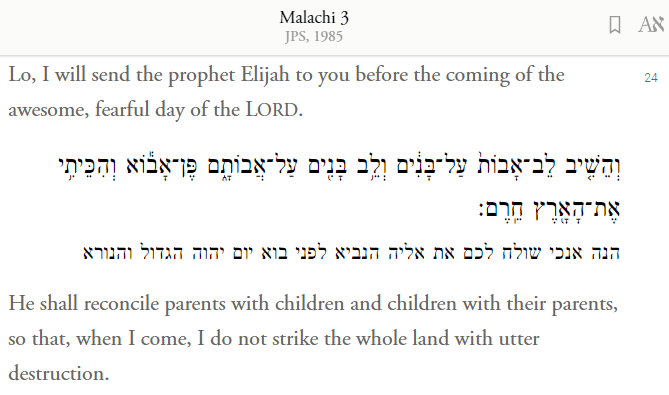
The prophesy in Malachi tells of Elijah’s return and is expressed in the King James translation as:
Behold I will send you Elijah the prophet before the coming of the great and dreadful day of the Lord:
And he shall turn the heart of the fathers to the children,
and the heart of the children to their fathers,
lest I come and smite the earth with a curse.
This prophesy is reiterated in Luke 1:16-17 by the angel who announced to Zacharias the priest that his wife Elizabeth would conceive and bear their son, who would later be known as John the Baptist, the angel then proceeded to say of John:
… he shall be filled with the Holy Ghost, even from his mother’s womb. And many of the children of Israel shall he turn to the Lord their God. And he shall go before him in the spirit and power of Elias (Elijah), to turn the hearts of the fathers to the children, and the disobedient to the wisdom of the just; to make ready a people prepared for the Lord.
Luke 1:16-17
We know Elijah did actually come back physically on the “mountain of transfiguration” as we’re told in Matthew 17:3 “Suddenly Moses and Elijah appeared before them, talking with Jesus.”, but with the words of the angel considered, we can understand what Jesus was saying when He told the disciples in Matthew 17 that John the Baptist was Elijah:
But I tell you that Elijah has already come, and they didn’t recognize him,
but have done to him whatever they wished.
In the same way, the Son of Man will suffer at their hands.
Then the disciples understood that He was speaking to them about John the Baptist.
Matthew 17:12-13
An important aspect of John the Baptist’s ministry revealed here, is also spoken of in the Malachi passage: “And he shall turn the heart of the fathers to the children, and the heart of the children to their fathers”, which is made clearer to us by Luke, where he reiterates the “father – children” relationship, being one that is not restricted to an expression of being a family relationship, but one of teacher and student, as representative of those who are learning from those who have greater knowledge, but through the revelation of the gospel of Jesus by John the Baptist, the children and the fathers who accepted the gospel teaching, were reconciled by repenting from the traditional Jewish teachings, to Christ, through this, their hearts were turned to each other in love.
This “father- children” typology is again later reiterated through Jesus prayer in Luke 10:21; “At that time Jesus rejoiced in the Holy Spirit and declared, “I praise You, Father, Lord of heaven and earth, because You have hidden these things from the wise and learned, and revealed them to little children. Yes, Father, for this was well-pleasing in Your sight. “. John the Baptist’s teaching also more broadly turned the “disobedient to the wisdom of the just” from throughout the Jewish nation, as prophesied by the angel to Zacharias, as we read earlier in Luke 1:17
Then he said to the multitude that came out to be baptized of him,
Luke 3:7-10
O generation of vipers, who has warned you to flee from the wrath to come?
Bring forth therefore fruits worthy of repentance, and begin not to say within yourselves,
We have Abraham to our father:
for I say to you, That God is able of these stones to raise up children to Abraham.
And now also the ax is laid to the root of the trees: every tree therefore which brings not forth good fruit is hewn down, and cast into the fire.
And the people asked him, saying, What shall we do then?
John the Baptist then told the multitude of people what to do, these ones who he had called “generation of vipers”, included the general population as well as soldiers and tax collectors, and they were all being prepared by his delivery of the gospel to be washed of their sin through Christ Jesus, so that they would not be found still in their sin at “the great and dreadful day of the Lord“.
- In regard to the sub-topic of John’s Baptism; We’re told of this in John 1:31 “… the reason I came baptizing with water was that He might be revealed to Israel.”
- Then this reasoning is further mentioned in Matthew 3:1-12 “In those days John the Baptist came, preaching in the wilderness of Judea and saying, “Repent, for the kingdom of heaven is near.”
3 This is he who was spoken of through the prophet Isaiah: “A voice of one calling in the wilderness, ‘Prepare the way for the Lord, make straight paths for Him.’ ” 4 John wore a garment of camel’s hair, with a leather belt around his waist. His food was locusts and wild honey.
5 People went out to him from Jerusalem and all Judea and the whole region around the Jordan.
6 Confessing their sins, they were baptized by him in the Jordan River.
7 But when John saw many of the Pharisees and Sadducees coming to his place of baptism, he said to them, “You brood of vipers, who warned you to flee from the coming wrath?
8 Produce fruit, then, in keeping with repentance.
9 And do not presume to say to yourselves, ‘We have Abraham as our father.’ For I tell you that out of these stones God can raise up children for Abraham.
10 The axe lies ready at the root of the trees, and every tree that does not produce good fruit will be cut down and thrown into the fire.
11 I baptize you with water for repentance, but after me will come One more powerful than I, whose sandals I am not worthy to carry. He will baptize you with the Holy Spirit and with fire.
12 His winnowing fork is in His hand to clear His threshing floor and to gather His wheat into the barn; but He will burn up the chaff with unquenchable fire.”
There is also more information given for the reason of John’s Baptism in Luke 7:27-35 “This is the one about whom it is written: ‘Behold, I will send My messenger ahead of You, who will prepare Your way before You.’ 28 I tell you, among those born of women there is no one greater than John, yet even the least in the kingdom of God is greater than he.” 29 All the people who heard this, even the tax collectors, acknowledged God’s justice. For they had received the baptism of John.
(Luke 7:29 is delivered a little more clearly in the T4T translation: “When they heard what Jesus said (OR, what John preached), all the people, including tax collectors, whom many people despised, agreed that God’s way was right. By being baptized by John {By letting John baptize them}, they had agreed that what God required people to do in order to be saved was right.”)
30 But the Pharisees and experts in the law rejected God’s purpose for themselves, because they had not been baptized by John.
31 “To what, then, can I compare the men of this generation? What are they like?
32 They are like children sitting in the marketplace and calling out to one another: ‘We played the flute for you, and you did not dance; we sang a dirge, and you did not weep.’
33 For John the Baptist came neither eating bread nor drinking wine, and you say, ‘He has a demon!’
34 The Son of Man came eating and drinking, and you say, ‘Look at this glutton and drunkard, a friend of tax collectors and sinners!’
35 But wisdom is vindicated by all her children.”
When John the Baptist said he wasn’t Elijah, it’s clear that he knew who he was from a physical point of view, and he may not have recognised himself as being the fulfilment of the prophesy that the Jews were referring to, although he certainly knew he was fulfilling the roll of the prophesy of Isaiah as he said of himself in John 1:23 “…I am the voice of one crying in the wilderness, Make straight the way of the Lord, as said the prophet Esaias.”, but as a man known for his humility he may not have wanted to be elevated in their minds by being spoken of as the great prophet Elijah. But it is certainly understandable that the Jews asked John the Baptist the question, because his appearance alone was very similar to that of Elijah’s as we see in the following verses:
2 KIng’s 1:8
And they answered him,
He was a hairy man, and girt with a girdle of leather about his loins.
And he said, It is Elijah the Tishbite.
Matthew 3:4
And the same John had his clothing of camel’s hair, and a leather girdle about his loins; and his food was locusts and wild honey.
and Mark 1:6
And John was clothed with camel’s hair, and with a girdle of a skin about his loins; and he ate locusts and wild honey;
The aspect of God putting the same Spirit and power of Elijah into John the Baptist, is also spoken of in Numbers 11 regarding Moses and the elders:
And the LORD came down in a cloud, and spoke to him, and took of the spirit that was on him, and gave it to the seventy elders: and it came to pass, that, when the spirit rested on them, they prophesied, and did not cease.
Numbers 11:25
Then again similarly in 2 Kings 2:15 we’re told of the spirit of Elijah being given to Elisha in a “double portion” as Elisha had requested in verse 8, to continue the work of God among the people:
When the sons of the prophets who were facing him from Jericho saw what had happened, they said, “The spirit of Elijah rests on Elisha.” And they went to meet him and bowed down to the ground before him.
so also the Spirit and power that was given for God’s purpose in Elijah, was also given to John the Baptist, empowering him to warn the people of the penalty of their sins and to boldly tell them to repent from their ungodly ways to do God’s will through Christ, which subsequently turned the heart of many fathers to the children and the children to the fathers ; “to make ready a people prepared for the Lord.”
“Are you that prophet?“
This last question was asked because of the prophesy spoken by Moses in Deuteronomy 18.
The Lord your God will raise up for you a prophet like me from among you, from your fellow Israelites. You must listen to him.
Deuteronomy 18:15
This reference is also mentioned in Acts 3
Repent, then, and turn back, so that your sins may be wiped away, that times of refreshing may come from the presence of the Lord, and that He may send Jesus, the Christ, who has been appointed for you.
Acts 3:19-23
Heaven must take Him in until the time comes for the restoration of all things,
which God announced long ago through His holy prophets. For Moses said, ‘The Lord your God will raise up for you a prophet like me from among your brothers. You must listen to Him in everything He tells you.
Everyone who does not listen to Him will be completely cut off from among his people.’
Note we’re told here that “Heaven must take Him in until the time comes for the restoration of all things, “, and Revelation 12:5 also reiterates this verse “…And she brought forth a man child, who was to rule all nations with a rod of iron: and her child was caught up unto God, and to his throne.“, He was received up into heaven and will appear in the clouds to receive His church (2 Timothy 4:8 “From now on there is laid up for me a crown of righteousness, which the Lord, the righteous judge, shall give me at that day: and not to me only, but to all them also that love his appearing.”), then He will come later “for the restoration of all things”. I believe that the one spoken of in this prophesy by Moses in Deuteronomy and reiterated in Acts is Jesus Christ Himself who is also spoken of in John 6 & 7 as “the prophet”:
When the people saw the sign that Jesus had performed, they began to say, “Truly this is the Prophet who is to come into the world.”
John 6:14
On hearing these words, some of the people said, “This is truly the Prophet.”
John 7:40
What a blessing to read again verse 21 of chapter 1
They asked him,
“Then who are you?
Are you Elijah?”
He said, “I am not.”
“Are you the Prophet?”
He answered, “No.”
And in reading this verse, even the Pharisees questions serve to glorify God as they show that through Christ, God has of course honoured His promise of salvation which was spoken through Moses about 1500 years before Christ came!
God always honours His promises, a particular one I love is from Romans 8:1
Therefore, there is now no condemnation for those who are in Christ Jesus.
And also further on in the same chapter:
For those God foreknew, He also predestined to be conformed to the image of His Son, so that He would be the firstborn among many brothers.
Romans 8:31-39
And those He predestined, He also called;
those He called, He also justified;
those He justified, He also glorified.
What then shall we say in response to these things? If God is for us, who can be against us?
He who did not spare His own Son but gave Him up for us all,
how will He not also, along with Him, freely give us all things?
Who will bring any charge against God’s elect? It is God who justifies.
Who is there to condemn us? For Christ Jesus, who died, and more than that was raised to life, is at the right hand of God—and He is interceding for us.
Who shall separate us from the love of Christ?
Shall trouble or distress or persecution or famine or nakedness or danger or sword?
As it is written: “For Your sake we face death all day long; we are considered as sheep to be slaughtered.”
No, in all these things we are more than conquerors through Him who loved us.
For I am convinced that neither death nor life,
neither angels nor principalities,
neither the present nor the future,
nor any powers,
neither height nor depth,
nor anything else in all creation,
will be able to separate us from the love of God that is in Christ Jesus our Lord.
APO 15Jul22&25Apr24
 Study like a Berean!