

Index
- Conditional or Unconditional Forgiveness, that was the question.
- God’s sovereignty and man’s responsibility
- Considering six types of forgiveness in the New Testament:
- 1. aphesis G859: God’s forgiveness to Eternal Salvation.
- 2. aphiēmi G863: to send away, to let go, to give up a debt…
- aphiēmi (G863 ), when interpreted as forgive/n, is used in:
- Forgiven: Healed of a present (earthly) penalty of sin.
- Father, forgive (aphiēmi) them… :
- God’s aphiēmi, can still include a penalty.
- Discipline should be coupled with love to restore;
- Aphiēmi withheld by God, so that mercy is not given:
- What can earthly penalty consist of?
- Unconditional aphiēmi, person to person:
- Aphiēmi (forgiving) & responding to being sinned against. Considering Luke 17:3-4
- Go to the offender, take another, tell it to the Church: Matthew 18:15-17
- Some important points to consider before proceeding to bring another persons error to their attention:
- Conditional forgiveness between Christians can bring God’s discipline to the unforgiving person:
- 3. Charizomai G5483: a. God’s forgiveness to maintain fellowship of men with God. b. Interpersonal forgiveness, encouraging reconciliation.
- 4. apoluō G630: to set free…
- 5. epikaluptō G1943 & kaluptō G2572: to conceal, to cover
- Practical considerations of forgiveness between people:
- Brief consideration of the word “Judge”:
- Preserving the rights of others.
- “for His mercies are great”
Conditional or Unconditional Forgiveness, that was the question.
The reason for me considering the topic of forgiveness was that, in the congregation where I spent most of my life, I was taught that God doesn’t forgive without repentance so we shouldn’t either, this perception, which is contrary to scriptural instruction, became a substantial doctrine in the latter years there, and was written of by a deacon in the bulletin one Sunday morning, endorsed by the pastor and elders, it became a substantial source of division:
“Forgive, forgive, forgive???? Lately I am fed up with hearing that we ought to forgive everyone for everything. God does not forgive everyone and does not tell us to either.
No-one gets forgiveness with God without repenting first.”
With the assistance of 2 important points, I believe understanding and correct application of scripture can be achieved with result of the Body of Christ fellowshipping in love:
- Identifying & understanding the Greek words and meanings which have been interpreted as forgive/n/ness…
- Understanding the nature of the word in context to the surrounding text:
- For example the verse of Matthew 6:15 quoted after the next paragraph could be taught as a warning of eternal penalty in hell or as a warning of earthly discipline with accountability after death, only one interpretation is right, it’s the latter, the key to this comes from the type of forgiveness (aphiēmi) used in the text, it’s not forgiveness (aphesis) related to eternal salvation; the difference of these two types of forgiveness and the other types are shown through this doc.
God’s sovereignty and man’s responsibility
At the individual personal level between God and man, salvation through Christ to eternal forgiveness is of course foundational and one of the most important doctrines of the Christian faith, however, in the application of forgiveness between persons, depending on individual or congregational perspective of forgiveness being either Conditionally or Unconditionally applied, the subsequent actions or inactions of the responsibility of man can be the cause of splitting congregations of Christians or saving marriages, and in each of these and other instances of the applied belief there are subsequent “roll-on” effects to the lives of more than those immediately active in the process. This is not a light matter, consider the possible results of withholding forgiveness as referred to in the following verses:
If you forgive (charizomai) anyone anything, I too forgive (charizomai); and what I have forgiven (charizomai), if I have forgiven (charizomai) anything, has been for your sake in the presence of Christ,
2 Corinthians 2:10-11
to keep Satan from taking advantage of us; for we are not ignorant of his schemes.
But if you do not forgive (aphiēmi) men their trespasses,
Matthew 6:15
neither will your Father forgive (aphiēmi) your trespasses.
A couple of introductory points for consideration:
- The term “man” when used throughout this document is often abbreviated from “mankind” which is inclusive impartially of both male & female.
- I don’t claim to have written the absolute truth here, my perception of what I think I understand, can get in the way of what I still have to learn (I don’t believe any man can claim that all that he expresses is true, only God is perfect. Consider Acts 17:11*), but I pray you also will find more revelation of the glory of God and experience His peace through application of forgiveness as you compare what’s written here, with the Word of God. *Study like a Berean, to see if it is so.
Research of the pre-translation words comes before teaching:
In most bibles the words forgive/n/ness, are the same in each use despite the Greek word being any 1 of 4 different words, understandably when the word is misinterpreted it affects the application of it within its perceived use and can form the base of substantial error in teaching (doctrine), so a Bible translation which provides the original Greek word or an adjacent number to identify the original Greek word is often necessary to see the difference, I use a bible app. on my phone (screen shot shown below) which gives a number to each translated word to identify the Hebrew (H) or Greek (G) word which the English (or chosen language) word was translated from, these are known as Strong’s numbers,
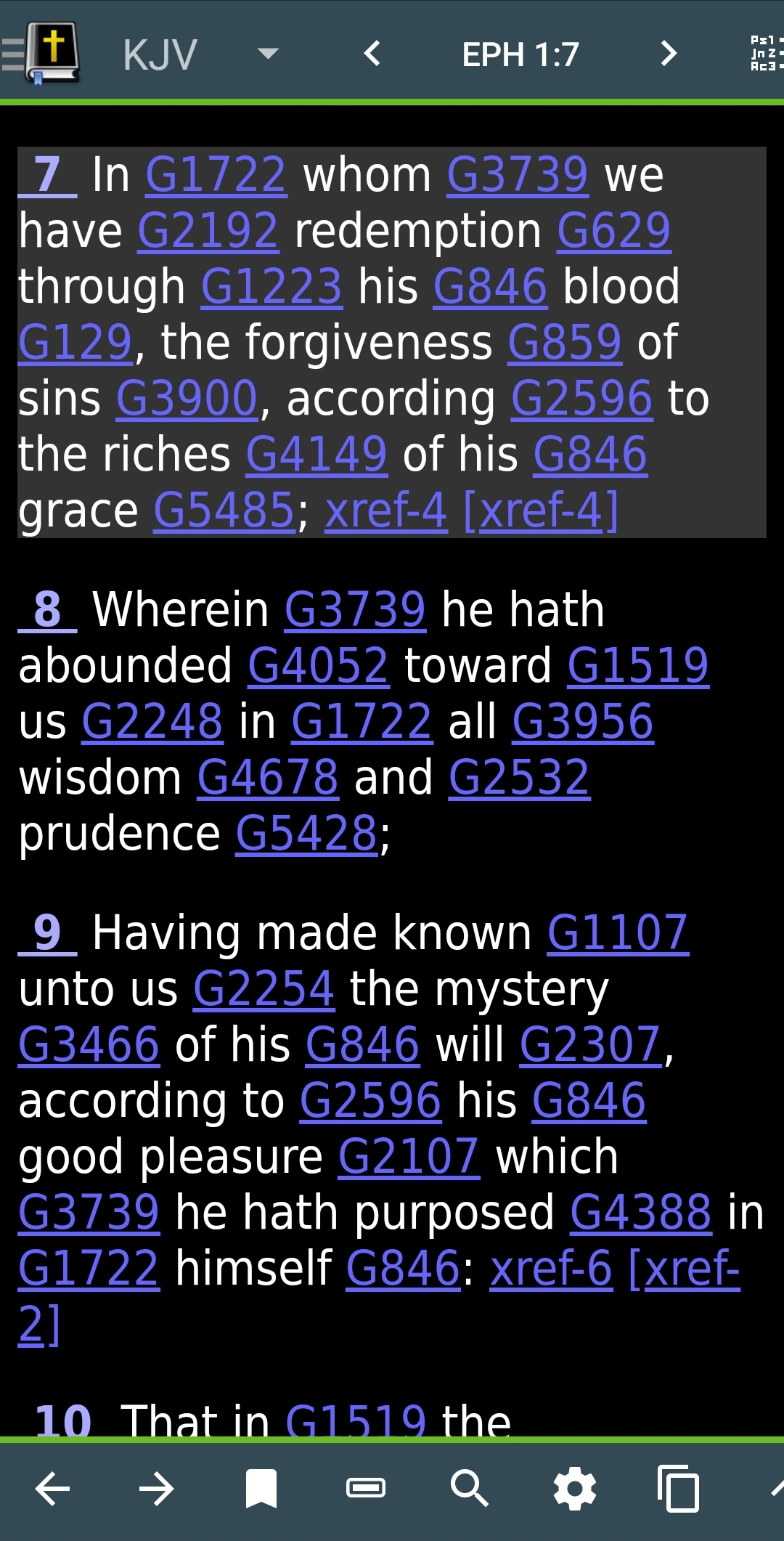
Although there are many people who have no knowledge of the Greek original words for forgive/ness, by God’s grace many have a very clear understanding of the differing applications of the words, however there are others who for whatever reason, teach or hold to a perspective that there is no difference from God’s eternal forgiveness to salvation which is subject to repentance, and the forgiveness’s applied between persons. This perspective denies, or doesn’t understand the distinct differences between each of the Greek words from which the translated word originates. By looking into the origin of the translated word there are in fact no less than four Greek words from which forgive has been translated. The Greek words are aphesis, aphiēmi, charizomai, and apoluō, as well as two other words; epikaluptō and kaluptō, which are also forgiveness, but are translated as “cover”. As you read through, they’re given with their relevant uses in regard to this topic; I say “in regard to this topic“, because each of these words also have application in other instances subject to the context in which they’re used, as in the following example:
- aphiēmi (G863), in 1 context, can be applied as:
to leave, go way from one, in order to go to another place.
– while in another context, can be applied as:
to leave, go way from one, to desert wrongfully.–
– or in another context:
to let go, give up a debt, forgive, to remit.
– or other context’s:
1 to send away.
a. to bid going away or depart
1. of a husband divorcing his wife.
c. to let go, let alone, let be
1. to disregard
2. to leave, not to discuss now, (a topic)
- aphiēmi (G863), in 1 context, can be applied as:
And there are more applications also subject to context, but in the following overview I’ve only expanded on those relevant to the way many often perceive the word we’re more familiar with: forgive.
The differences of “forgive” are substantial.
The main focus of what I wish to share in this article, is the distinct difference of the glorious saving forgiveness (aphesis) of God, and the beautiful application and fruit of forgiveness (aphiēmi, charizomai, apoluō, epikaluptō and kaluptō) between God & men, & between man & man. Colossians 2:2-3 “That their hearts might be comforted, being knit together in love, and unto all riches of the full assurance of understanding, to the acknowledgement of the mystery of God, and of the Father, and of Christ; In whom are hid all the treasures of wisdom and knowledge.”
A few considerations in regard to forgiveness between persons;
(These points are lightly considered throughout this overview)
- The application of forgiveness by persons can play a substantial part in the process of maintaining relationships and working toward restoring them, but its application doesn’t always deliver these results. Although the commandment to love our enemies requires practical actions in the forgiver, it doesn’t guarantee repentance by the forgiven, but forgiveness & other forms of love should not be applied dependant on how they are expected to be received, they should be applied in obedience to God in humility, denying self and following Jesus’ example for the glory of God in love for both Him and the person concerned.
- 1 Corinthians 13:1-3 “Though I speak with the tongues of men and of angels, and have not charity (G26), I am become as sounding brass, or a tinkling cymbal. And though I have the gift of prophecy, and understand all mysteries, and all knowledge; and though I have all faith, so that I could remove mountains, and have not charity (G26), I am nothing. And though I bestow all my goods to feed the poor, and though I give my body to be burned, and have not charity (G26), it profits me nothing.”
This agapē: love is different to other forms of love such as: storge: natural or instinctual affection, as of a parent for a child.
- 1 Corinthians 13:1-3 “Though I speak with the tongues of men and of angels, and have not charity (G26), I am become as sounding brass, or a tinkling cymbal. And though I have the gift of prophecy, and understand all mysteries, and all knowledge; and though I have all faith, so that I could remove mountains, and have not charity (G26), I am nothing. And though I bestow all my goods to feed the poor, and though I give my body to be burned, and have not charity (G26), it profits me nothing.”
- Forgiving requires humility, which is based on the knowledge that we are all sinners in regular need of God’s forgiveness in this world:
- Ref. Mathew 6:12 “And forgive (aphiēmi) us our debts, as we forgive (aphiēmi) our debtors.“
- Humility may include;
- giving up your own “rights”, being perceived as weak,
- being defrauded in reputation, relationship, possession or finance.
- Forgiveness should be accompanied by prayer for the offender:
- Luke 6:27-30 “But I say to you who hear, love your enemies, do good to those who hate you, bless those who curse you, pray for those who disparage you. Whoever hits you on the cheek, offer him the other also; and whoever takes away your garment, do not withhold your undergarment from him either…“
- Acts 7:59-60 “And they stoned Stephen as he was calling on God and saying, ‘Lord Jesus, receive my spirit.’ Then he knelt down and cried out with a loud voice, ‘Lord, do not charge them with this sin.‘ And when he had said this, he fell asleep.“
- Luke 23:33-34 “When they came to the place called the Skull, they crucified him there, along with the criminals—one on his right, the other on his left. Jesus said, “Father, forgive them, for they do not know what they are doing.”
- Forgiveness may be as simple as considering the offence as having never occurred:
- 1 Peter 4:8 “And above all things have fervent charity (love) among yourselves: for charity (love) shall cover (kalyptō) the multitude of sins.“
- 1 Peter 4:8 “And above all things have fervent charity (love) among yourselves: for charity (love) shall cover (kalyptō) the multitude of sins.“
- Forgiveness may include releasing the offender from full repayment of a debt:
- Matthew 18:27 “Then the lord of that servant was moved with compassion, and loosed him, and forgave (aphiēmi) him the debt“
- Matthew 18:27 “Then the lord of that servant was moved with compassion, and loosed him, and forgave (aphiēmi) him the debt“
- Forgiveness may include giving financial or material assistance to the offender, Christians are exhorted to practically apply their faith just as Jesus did, He didn’t just think or speak about it:
- Genesis 3:11&21 “And he said, ‘Who told you that you were naked? Have you eaten from the tree that I commanded you not to eat from?’…The Lord God made garments of skin for Adam and his wife and clothed them.“
- Philemon 15-18 regarding Onesimus : “Perhaps the reason he was separated from you for a little while was that you might have him back forever— no longer as a slave, but better than a slave, as a dear brother. He is very dear to me but even dearer to you, both as a fellow man and as a brother in the Lord. So if you consider me a partner, welcome him as you would welcome me. If he has done you any wrong or owes you anything, charge it to me.”
- Forgiving doesn’t necessarily restore trust, It’s an act of obedience to God but it doesn’t necessarily change the recipient, so they may need to be discreetly observed in the interest of preserving the rights of others who could be negatively affected by them, time may be required to assess if they have changed their ways (repented). Trust extends opportunity to people who have shown that they are honourably responsible.
- Philemon 10-11 “I appeal to you for my son Onesimus, whom I have begotten while in my chains, who once was unprofitable to you, but now is profitable to you and to me.“
- Philemon 10-11 “I appeal to you for my son Onesimus, whom I have begotten while in my chains, who once was unprofitable to you, but now is profitable to you and to me.“
- Forgiving doesn’t guarantee reconciliation will follow, but it’s our responsibility and should be our hope to work to this end:
- ″… that God was in Christ, reconciling the world unto himself, not imputing their trespasses unto them; and has committed unto us the word of reconciliation.” 2 Corinthians 5:19
- Reconciliation is dependant on at least 2 persons, though application of love is no guarantee of reconciliation it’s the action which facilitates the possibility.
“If it is possible, as much as depends on you, live peaceably with all men.” Romans 12:18
- Forgiving doesn’t mean you will never remember a wrong (it would be great if you could, and you may actually be able to…), but it means you would not use your knowledge of the fault as a reason to apply any sort of spite, action of revenge, or to raise yourself in your own, or in others perception at the expense of the offending person, but rather you would relate to the person in humility in kindness viewing them as better than yourself.
- Hebrews 10:17 “And their sins and iniquities I will remember no more.“
- Philippians 2:3-4 “Let nothing be done through selfish ambition or conceit, but in lowliness of mind let each esteem others better than himself. Let each of you look out not only for his own interests, but also for the interests of others.“
- Forgiveness may still require penalty to be applied in the case of some offences so that the law is known as a deterrent to lawlessness and to discourage persons from reoffending.
- Righteousness preserves the rights of the oppressed and mistreated. A forgiven person may need to be separated from or restrained, because they have minimal self control and could continue or progress to injure or harm (by mental or physical means) the person/s in their home or other environment. God has established various levels of government both in the Church and in society, to administer law for the preservation of peace and safety, (Where these governments fail, God still works in the lives of all, and after this life, He holds man responsible, at His heavenly throne).
- 1 Timothy 1:8-11 “But we know that the law is good if one uses it lawfully, knowing this: that the law is not made for a righteous person, but for the lawless and insubordinate, for the ungodly and for sinners, for the unholy and profane, for murderers of fathers and murderers of mothers, for manslayers, for fornicators, for sodomites, for kidnappers, for liars, for perjurers, and if there is any other thing that is contrary to sound doctrine, according to the glorious gospel of the blessed God which was committed to my trust.”
- 2 Samuel 12:13-14 “The Lord also has put away your sin; you shall not die. However, because by this deed you have given great occasion to the enemies of the Lord to blaspheme, the child also who is born to you shall surely die.”
- Ecclesiastes 8:11 “Because the sentence against an evil work is not executed speedily, therefore the heart of the sons of men is fully set in them to do evil.“
- Romans 13:3 “For rulers are not a cause of fear for good behavior, but for evil. Do you want to have no fear of that authority? Do what is good, and you will have praise from the same;“
- Acts 5:1-11 Ananias & Sapphira died as result of lying to Holy Spirit.
- Numbers 12:1-15. Miriam was made leprous and was separated from the Israelites for 7 days because of her sin, then was allowed to re-join the people after that time.
- Righteousness preserves the rights of the oppressed and mistreated. A forgiven person may need to be separated from or restrained, because they have minimal self control and could continue or progress to injure or harm (by mental or physical means) the person/s in their home or other environment. God has established various levels of government both in the Church and in society, to administer law for the preservation of peace and safety, (Where these governments fail, God still works in the lives of all, and after this life, He holds man responsible, at His heavenly throne).
Each scenario needs to be considered carefully, subject to God’s wisdom, based on His Word. A document as brief as this, can’t deal adequately with the wisdom required for application in each scenario, that’s where God provides council through His Word, Holy Spirit, Prayer, the Saints and His ministers (Romans 13:4).
Some antonyms (opposites) of forgive:
Condemn, Accuse, Blame, Hold, Increase, Maintain, Keep, …
Considering six types of forgiveness in the New Testament:
- aphesis G859: In the context of God’s forgiveness relating to “repentance to life“
- aphiēmi G863: In the context of God’s forgiveness rather than applying penalty (earthly).
- charizomai G5483: In the context of God’s forgiveness to maintain fellowship with Him.
3b. charizomai G5483: In the context of Man’s forgiveness to maintain fellowship with man. - apoluō G630: In the context of mans forgiveness of a debt.
- epikaluptō G1943: In the context of the blessing of forgiveness through the work of Christ, as distinctly recognising that there is no ability for man to gain forgiveness through his own works, and that the Lord will never count that man’s sin against him. refer to Romans 4:7 (from Psalm 32:1) covered (to conceal, that is, (figuratively) forgive: – cover.
- kaluptō G2572: In the context of man’s forgiveness as an action of love, with the result of saving another from “the misery of the soul arising from sin…”
Each of the above forms of forgiveness have results from their application, subject to the individuals relationship with God:
- Without the first (aphesis to salvation) being granted, there’s no application of the third (charizomai to fellowship with God), because without God accepting man’s repentance, man can’t have fellowship with Him; as stated in 2 Corinthians 6:14-17 “…for what fellowship has righteousness with unrighteousness? and what communion has light with darkness?…”
- Without the first being granted (aphesis to salvation) there’s only temporary earthly benefit to come from a person’s application of the second, third and fourth, or sixth (aphiēmi, charizomai apoluō & kaluptō, for fellowship or release of debt between people), because regardless of how “righteously” people apply forgiveness, only the blood of Christ can forgive people’s eternal debt and guilt of sin, so even if things are “sorted out between people”, neither party will enjoy the result of aphesis (forgiveness to salvation) if God hasn’t granted repentance to salvation.
In consideration of the six types of forgiveness in the New Testament, if you apply one rule across the six types, among other errors you will confuse soteriological* repentance (*repentance to salvation), which in Greek is predominantly aphesis, with God’s instruction for person to person (and on some occasions God to man) forgiveness which are aphiēmi, charizomai, apoluō and kaluptō, which don’t confer eternal salvation.
1. aphesis G859:
God’s forgiveness to Eternal Salvation.
Thayer Definition:
1. release from bondage or imprisonment.
2. forgiveness or pardon, of sins (letting them go as if they had never been committed), remission of the penalty.
Strong’s Definition:
From G863; freedom; (figuratively) pardon:- deliverance, forgiveness, liberty, remission.
To be saved from the debt of our sin, requires God’s redeeming work through Christ:
Wherefore, as by one man sin entered into the world, and death by sin; and so death passed upon all men, for that all have sinned:15 But not as the offence, so also is the free gift. For if through the offence of one many be dead, much more the grace of God, and the gift by grace, which is by one man, Jesus Christ, has abounded unto many.
Romans 5:12
There are two primary results of God’s forgiveness (aphesis) through Christ:
1) When a persons receives eternal salvation from their sin debt, they are eternally free from penalty and made heirs of Gods blessings.
- Ephesians 1:7 “In Him we have redemption through His blood, the forgiveness (aphesis) of sins, according to the riches of His grace”
2) When God applies aphesis, He removes the guilt* of sin.
(*The feeling of grief from the shame and responsibility of a sinful life.)
Only God can take away guilt, all sin is first of all an act of disobedience to God, so this disobedience requires accountability first to God. When forgiveness is received through Jesus by faith, repentance and confession, the debt to God is cancelled so the person is free from the penalty.
- John 8:36 “If the Son therefore shall make you free (eleutheroō), you shall be free indeed.“
Strongs Definition G1659 eleutheroō: To liberate, that is, (figuratively) to exempt (from moral, ceremonial or mortal liability)…
Aphesis: The only forgiveness to eternal salvation.
Of the 6 forms of “forgiveness” considered here from the New Testament, aphesis is the only form of forgiveness which enables eternal salvation through Christ.
I’ve found it’s use on 17 occasions only:
- Matthew 26:28 “For this is my blood of the new testament, which is shed for many for the remission (aphesis) of sins.“
- Mark 1:4 “John did baptize in the wilderness, and preach the baptism of repentance for the remission (aphesis) of sins.“
- Mark 3:29 “But he that shall blaspheme against the Holy Ghost has never forgiveness (aphesis), but is in danger of eternal damnation:“
- Luke 1:77 “To give knowledge of salvation unto his people by the remission (aphesis) of their sins,“
- Luke 3:3 “And he came into all the country about Jordan, preaching the baptism of repentance for the remission (aphesis) of sins;“
- (a&b) Luke 4:18 “The Spirit of the Lord is upon me, because he has anointed me to preach the gospel to the poor; he has sent me to heal the broken hearted, to preach deliverance (aphesis) to the captives, and recovering of sight to the blind, to set at liberty (aphesis) them that are bruised,“
- Luke 24:47 “And that repentance and remission (aphesis) of sins should be preached in his name among all nations, beginning at Jerusalem.“
- Acts 2:38 “Then Peter said unto them, Repent, and be baptized every one of you in the name of Jesus Christ for the remission (aphesis) of sins, and you shall receive the gift of the Holy Ghost.“
- Acts 5:31 “Him has God exalted with his right hand to be a Prince and a Saviour, for to give repentance to Israel, and forgiveness (aphesis) of sins.“
- Acts 10:43 “To him give all the prophets witness, that through his name whosoever believes in him shall receive remission (aphesis) of sins.“
- Acts 13:38 “Be it known unto you therefore, men and brethren, that through this man is preached unto you the forgiveness (aphesis) of sins:“
- Acts 26:18 “To open their eyes, and to turn them from darkness to light, and from the power of Satan unto God, that they may receive forgiveness (aphesis) of sins, and inheritance among them which are sanctified by faith that is in me.“
- Ephesians 1:7 “In whom we have redemption through his blood, the forgiveness (aphesis) of sins, according to the riches of his grace;“
- Colossians 1:14 “In whom we have redemption through his blood, even the forgiveness (aphesis) of sins:“
- Hebrew 9:22 “And almost all things are by the law purged with blood; and without shedding of blood is no remission (aphesis).“
- Hebrews 10:18 “Now where remission (aphesis) of these is, there is no more offering for sin.“
I believe aphesis is the most glorious of all forms of forgiveness, because, through Holy Spirit working in the recipient and the good news of salvation being preached, God grants faith, repentance and confession which provide eternal salvation through the blood of Christ, in which people are delivered from their sin and it’s guilt, are blessed with the riches of God’s eternal grace, and are given a new way of life to experience and express characteristics of Christ.
Romans 10:14-15 “How then shall they call on him in whom they have not believed? and how shall they believe in him of whom they have not heard? and how shall they hear without a preacher? 15 and how shall they preach, except they be sent? as it is written, How beautiful are the feet of them that preach the gospel of peace, and bring glad tidings of good things!”
Don’t exchange aphesis (forgiveness to eternal salvation) with any of the other 5 forms of forgiveness. The following forms of forgiveness, are not spoken of as specifically preceding and/or leading to or granting eternal salvation.
2. aphiēmi G863: to send away, to let go, to give up a debt…
Thayer (American biblical scholar 1828-1901) Definition:
- to send away
- …
- …
- to let go, let alone, let be
- to disregard
- …
- …
- to let go, give up a debt, forgive, to remit
- to give up, keep no longer
- to permit, allow, not to hinder, to give up a thing to a person
- to leave, go away from one
- …
- …
- to depart from one and leave him to himself so that all mutual claims are abandoned
- 5,6,7,8,9…
Strong’s Definition: … in various applications:- forgive, …omit, …, remit, …
In The King James version, aphiēmi is interpreted: leave (52x), forgive (47x), suffer (14x), let (8x), forsake (6x), let alone (6x), miscellaneous (13x).
To gain a better understanding of the nature of this forgiveness, it’s helpful to have a better understanding of what is being forgiven; the Greek words pertaining to the debtor, the debt, the sin or trespass, are underlined in brackets next to the English word and can be selected to open a page link to provide more explanation subject to context. The following list gives a brief description of each of these words:
- opheilema: that which is owed
- that which is justly or legally due, a debt
- opheiletes: one who owes another, a debtor
- one held by some obligation, bound by some duty
- one who has not yet made amends to whom he has injured:
- opheilo:
- to owe
- to owe money, be in debt for
- that which is due, the debt
- opheilē
1. that which is owed
2. a debt
3. metaph. dues: specifically of conjugal duty
- paraptoma:
- To fall beside or near something
- a lapse or deviation from truth and uprightness.
- hamartia:
Equivalent to hamartano to be without a share in to miss the mark to err, be mistaken to miss or wander from the path of uprightness and honour, to do or go wrong to wander from the law of God, violate God’s law, sin
that which is done wrong, sin, an offence, a violation of the divine law in thought or in act collectively, the complex or aggregate of sins committed either by a single person or by many
- hamartēma: sin, evil deed
- kakia:
- malignity, malice, ill-will, desire to injure
- wickedness, depravity
- wickedness that is not ashamed to break laws
- evil, trouble
- anomia:
- the condition of without law
- because ignorant of it
- because of violating it
- contempt and violation of law, iniquity, wickedness
- the condition of without law
aphiēmi (G863 ), when interpreted as forgive/n, is used in:
- Matthew 6:12 “And forgive (aphiēmi) us our debts (opheilema), as we forgive (aphiēmi) our debtors (opheiletes).”
- Matthew 6:14-15 “For if you forgive (aphiēmi) men their trespasses (paraptoma), your heavenly Father will also forgive (aphiēmi) you: But if you don’t forgive (aphiēmi) men their trespasses (paraptoma), neither will your Father forgive (aphiēmi) your trespasses (paraptoma).”
- Matthew 9:2 “Then behold, they brought to Him a paralytic lying on a bed. When Jesus saw their faith, He said to the paralytic, “Son, be of good cheer; your sins (hamartia) are forgiven (aphiēmi) you.”
- Matthew 9:5-6 “For which is easier, to say, ‘Your sins (hamartia) are forgiven (aphiēmi) you,’ or to say, ‘Arise and walk’? But that you may know that the Son of Man has power on earth to forgive (aphiēmi) sins (hamartia) …”
- Matthew 12:31-32 “Therefore I say to you, every sin (hamartia) and blasphemy will be forgiven (aphiēmi) men, but the blasphemy against the Spirit will not be forgiven (aphiēmi) men. 32 Anyone who speaks a word against the Son of Man, it will be forgiven (aphiēmi) him; but whoever speaks against the Holy Spirit, it will not be forgiven (aphiēmi) him, either in this age or in the age to come.”
- Matthew 18:21 “Then came Peter to him, and said, Lord, how often shall my brother sin (hamartano) against me, and I forgiven (aphiēmi) him? till seven times?“
- Matthew 18:27 “Then the master of that servant was moved with compassion, released him, and forgave (aphiēmi) him the debt (daneion: loan).“
- Matthew 18:32 “Then his master, after he’d called him, said to him, ‘You wicked servant! I forgave (aphiēmi) you all that debt (opheilē) because you begged me.”
- Matthew 18:35 “So My heavenly Father also will do to you if each of you, from his heart, does not forgive (aphiēmi) his brother his trespasses (paraptoma).“
- Mark 2:5 “When Jesus saw their faith, He said to the paralytic, “Son, your sins (hamartia) are forgiven (aphiēmi) you.”
- Mark 2:7 “Why does this Man speak blasphemies like this? Who can forgive (aphiēmi) sins (hamartia) but God alone?”
- Mark 2:9-10 “Which is easier, to say to the paralytic, ‘Your sins (hamartia) are forgiven (aphiēmi) you,’ or to say, ‘Arise, take up your bed and walk’? But that you may know that the Son of Man has power on earth to forgive (aphiēmi) sins (hamartia)”—He said to the paralytic,”
- Mark 3:28 “Assuredly, I say to you, all sins (hamartēma) will be forgiven (aphiēmi) the sons of men, and whatever blasphemies they may utter; 29 but he who blasphemes against the Holy Spirit never has forgiveness (G859 aphesis), but is subject to eternal condemnation”
- Mark 4:12 “so that ‘Seeing they may see and not perceive, And hearing they may hear and not understand; Lest they should turn, And their sins (hamartēma) be forgiven (aphiēmi) them.’ ”
- Mark 11:25 “And whenever you stand praying ,if you have anything against anyone, forgive (aphiēmi) him, that your Father in heaven may also forgive (aphiēmi) you your trespasses (paraptoma). But if you do not forgive (aphiēmi) , neither will your Father in heaven forgive (aphiēmi) your trespasses (paraptoma).”
- Luke 5:20 “When He saw their faith, He said to him, “Man, your sins (hamartia) are forgiven (aphiēmi) you. And the scribes and the Pharisees began to reason, saying, “Who is this who speaks blasphemies? Who can forgive (aphiēmi) sins (hamartia) but God alone?”
- Luke 5:23-24 “Which is easier, to say, ‘Your sins (hamartia) are forgiven (aphiēmi) you,’ or to say, ‘Rise up and walk’? But that you may know that the Son of Man has power on earth to forgive (aphiēmi) sins (hamartia)…”
- Luke 7:47-48 “Therefore I say to you, her sins (hamartia), which are many, are forgiven (aphiēmi) , for she loved much. But to whom little is forgiven (aphiēmi) , the same loves little. Then He said to her, “Your sins (hamartia) are forgiven (aphiēmi) .”
- Luke 7:49 “And those who sat at the table with Him began to say to themselves, “Who’s this who even forgives (aphiēmi) sins (hamartia)?”
- Luke 11:4 “And forgive (aphiēmi) us our sins (hamartia), For we also forgive (aphiēmi) everyone who is indebted (opheilo) to us. …”
- Luke 12:10 “And anyone who speaks a word against the Son of Man, it will be forgiven (aphiēmi) him; but to him who blasphemes against the Holy Spirit, it will not be forgiven (aphiēmi) .”
- Luke 17:3-4 “Take heed to yourselves. If your brother sins (hamartano) against you, rebuke him; and if he repents, forgive (aphiēmi) him. And if he sins (hamartano) against you seven times in a day, and seven times in a day returns to you, saying, ‘I repent,’ you shall forgive (aphiēmi) him.”
- Luke 23:34 “Then Jesus said, ‘Father, forgive (aphiēmi) them, for they do not know what they do.’…”
- John 20:23 “If you forgive (aphiēmi) the sins (hamartia) of any, they are forgiven (aphiēmi) them; if you retain the sins of any, they are retained.”
- Acts 8:22 “Repent therefore of this your wickedness (kakia), and pray God if perhaps the thought of your heart may be forgiven (aphiēmi) you.”
- Romans 4:7 “Blessed are those whose lawless deeds (anomia) are forgiven (aphiēmi) , And whose sins (hamartia) are covered;”
- James 5:15 “And the prayer of faith will save the sick, and the Lord will raise him up. And if he has committed sins (hamartia), he will be forgiven (aphiēmi) .”
- 1 John 1:9 “If we confess our sins (hamartia), He is faithful and just to forgive (aphiēmi) us our sins and to cleanse us from all unrighteousness.”
- 1 John 2:12 “I write to you, little children, Because your sins (hamartia) are forgiven (aphiēmi) you for His name’s sake.”
Forgiven: Healed of a present (earthly) penalty of sin.
Matthew 9:2 “And behold, they brought to him a paralyzed man, lying on a bed: and Jesus seeing their faith said to the man, Son, be of good cheer; your sins are forgiven (aphiēmi)….5 For which is easier, to say, Your sins are forgiven (aphiēmi); or to say, Arise, and walk? 6 But that you may know that the Son of man has authority on earth to forgive (aphiēmi) sins…”
Sickness is intrinsically linked to sin, it’s not necessarily a result of personal sin, but the relationship of sin to sickness is first evident in the record of the sin of Adam and Eve where they disobeyed God’s instruction, then deterioration commenced and continued to the point of death, just as they were warned of. This death wasn’t just a change from their perfect physical condition to a corrupt condition, but it was also a change from them existing in a form of moral purity in likeness to God, to being morally corrupt.
Genesis 2:17 But of the tree of the knowledge of good and evil, you shall not eat of it: for in the day that you eat of it you shall surely die.
Apart from the result of Adam’s sin causing death to all mankind, each individual person is personally accountable to God for their own sin, and some sins are noted in scripture as being the cause of sickness, as the following scriptures reveal:
- 1 Corinthians 11:29-30 “For those who eat and drink without discerning the body of Christ eat and drink judgement on themselves.30 That is why many among you are weak and sick, and a number of you have fallen asleep.“;
- John 5:7,8,14 “The invalid man answered him, Sir, I have no man, when the water is troubled, to put me into the pool: but while I am coming, another steps down before me. 8 Jesus said to him, Rise, take up your bed, and walk. 9 And immediately the man was made whole, and took up his bed 13 And he that was healed knew not who it was: for Jesus had taken himself away, a multitude being in that place. 14 Afterward Jesus found him in the temple, and said unto him, Behold, you are made whole: sin no more, lest a worse thing come unto you.“
- James 5:15 And the prayer of faith shall save the sick, and the Lord shall raise him up; and if he have committed sins, they shall be forgiven him.
- Proverbs 14:30 “A sound heart is life to the body, But envy is rottenness to the bones.“.
I’ve heard it was said to one of my relatives, that they were experiencing poor health because of their sin, which the accusing person said was that they had sinful thoughts toward their spouse. I don’t believe the person accused actually had these thoughts, and I don’t believe their ailment was attributable to them having sinned. It’s as wrong a perception as attributing an aching back to someone having sinned, when in actual fact their sore back came from applying incorrect weight lifting technique. But when sin is of the type that results in sickness, forgiveness can be accompanied by healing through Christ just as it was when He forgave sin to persons who also had subsequent benefit of being healed. But this forgiveness doesn’t mean the person is granted eternal life or that they are made free of future degradation from Adam’s sin or their own; take as example the man mentioned above who was told by Jesus to “Stop sinning or something worse may happen to you.” John 5:14. Note that Christians are commanded to forgive, so disobeying Gods instruction in this is in fact sinning, which separates the person from experiencing the fullness of fellowship with God which is a form of His earthly discipline.
As mentioned earlier, when aphiēmi is applied by God, the forgiven one isn’t granted eternal life as a result, so although the person may be forgiven for a particular sin, that type of forgiveness isn’t to eternal salvation, but interestingly and importantly, on one occasion of sin where aphiēmi isn’t granted by God, the person is actually unable to ever receive eternal salvation:
- Matthew 12:31-32
“Wherefore I say unto you, All manner of sin and blasphemy shall be forgiven (aphiēmi) unto men: but the blasphemy against the Holy Ghost shall not be forgiven (aphiēmi) unto men. And whosoever speaks a word against the Son of man, it shall be forgiven (aphiēmi) him: but whosoever speaks against the Holy Ghost, it shall not be forgiven (aphiēmi) him, neither in this age, nor in the coming one.”
Luke 12:10
And everyone who speaks a word against the Son of Man will be forgiven (aphiēmi), but anyone who blasphemes against the Holy Spirit will not be forgiven (aphiēmi).
Note: The above passages of scripture engage the word aphiēmi, which is used in scripture to convey: let go, let alone, let be, give up a debt, forgive, to remit, to give up, keep no longer… in relation to forgiveness of sinful acts or words that may require restitution to be made by the perpetrator, or may require a penalty to be applied to that person while they’re alive. However in Matthew there is a clear revelation that the person who speaks against the Holy Ghost (Holy Spirit) will not be forgiven in this age/world or in the age/world to come. And the reaffirmation of the eternal lost state of a person who expresses such dishonour to Holy Spirit is reiterated in Mark 3:29 where the word aphesis (deliverance, forgiveness, liberty, remission.) is used to state that forgiveness to eternal salvation will never be granted to one who speaks/blasphemes against Holy Spirit:Mark 3:29 but he who blasphemes against the Holy Spirit never has forgiveness (aphesis), but is subject to eternal condemnation.
Notice the statement at the end of Matthew 12:32; there is a distinct insight here; there can be forgiveness that is beneficial in this age/world which may be of no benefit in the age/world to come, and there is also a forgiveness that can be granted with benefit in this age/world and in the coming one. Now consider the following prayer by Jesus as He was on the cross:
Father, forgive (aphiēmi) them… :
“Then said Jesus, Father, forgive (aphiēmi) them; for they know not what they do. And they divided his garments, and cast lots.”
Luke 23:34
Note that the word “forgive” is aphiēmi, it’s not a term of forgiveness to eternal salvation (aphesis), but one of earthly remission (letting go…) of that sin. We’re not told whether the soldiers were later granted repentance to salvation (aphesis), but it’s evident that at the time they didn’t repent, because they continued on their selfish way casting lots for Christ’s clothing. If Christ hadn’t requested their forgiveness (aphiēmi) for the act of crucifying Him, they’re likely to have been penalised for their sin in a way such as is spoken of in the following verse; Lamentations 3:22 “It is of the LORD’S mercies that we are not consumed, because his compassion’s fail not.”; and consider the penalty of mortal death applied to Ananias and Sapphira for lying to God (Ref: Acts 5); or the penalty applied to Uzzah when he put his hand to steady the ark (Ref: 2 Samuel 6:6-7), he was struck dead by God; that could have been the lot of those who crucified Him also, but for God’s mercy.
You’d be aware of the character of God’s leniency in relation to application of penalty after judgement, it’s applied in homes, schools, workplaces and courtrooms around the world; it’s commonly known as mercy. It’s a responsibility of man to apply by God’s instruction, and God gives numerous examples of it’s application, starting with provision of covering for Adam & Eve after their sin, and later in The Word, it’s spoken of by the apostle Paul in 1 Timothy 1:12-13
“And I thank Christ Jesus our Lord, who has enabled me, for that he counted me faithful, putting me into the ministry; 13 Who was before a blasphemer, and a persecutor, and injurious: but I obtained mercy, because I did it ignorantly in unbelief.“. Some have said that Christ’s request of the Father for forgiveness (aphiēmi) to those who crucified Him, as recorded in Luke 23:34, wasn’t granted on this occasion; There are a few points I’d like to present for consideration regarding that perception:- I only know of one occasion where Christ requested conditionally of The Father: Luke 22:42 “Father, if it is Your will, take this cup away from Me; nevertheless not My will, but Yours, be done.”.
- Is it proposed that Christ didn’t forgive them even though He requested The Father to?
- Some people have told me that the Father denied Christ’s request to forgive those who crucified Him, this perception is contrary to Jesus’ words in John 12:49 where He said:
“For I have not spoken on My own authority; but the Father who sent Me gave Me a command, what I should say and what I should speak.” and John 3:34-35 where Jesus said of Himself “For He whom God has sent speaks the words of God, for God does not give the Spirit by measure. The Father loves the Son, and has given all things into His hand.“, Jesus was God manifest in flesh, God manifest in flesh requested The Fathers forgiveness (aphiēmi) for those who crucified Him, and it was done! Jesus said “the Father is in Me, and I in Him.” John 10:38, and Jesus told the Pharisees specifically regarding the time of His crucifixion: “Then Jesus said to them, “When you lift up the Son of Man, then you will know that I am He and that I do nothing of Myself; but as My Father taught Me, I speak these things.” John 8:28-29, though Jesus was truly man, He is truly God, God is not divided in Himself in Thought, Word or Action!- If, as proposed, “The Father denied Christ’s request”, then, what hope does any mortal have of The Father answering a man’s request in Christ’s name? If the proposal was so, the following three verses would be of doubtful or no value:
- John 14:13 “And whatsoever you shall ask in my name, that will I do, that the Father may be glorified in the Son.”
- John 15:16 “that whatsoever you shall ask of the Father in my name, he may give it you.”
- John 16:23 “Whatsoever you shall ask the Father in my name, he will give it you.”
- If, as proposed, “The Father denied Christ’s request”, then, what hope does any mortal have of The Father answering a man’s request in Christ’s name? If the proposal was so, the following three verses would be of doubtful or no value:
- To propose that when Christ unconditionally requested His Father to forgive (aphiēmi) those who crucified Him, that God The Father denied God The Son’s request? Considering that God was manifest in flesh as Christ, I wonder if anyone would venture to tell the Lord Jesus Christ (God The Son) that God The Father wouldn’t honour His unconditional request? When Christ said “And he that sent me is with me: the Father has not left me alone; for I do always those things that please him” John 8:29; It’s fact, that every word and act of Christ pleased The Father. Christ unconditionally requested forgiveness (aphiēmi) for the act of crucifying Him and because of this request I believe that their lives were spared to allow them time to repent to salvation before their death. Christ didn’t come to judge the world, but to save the world. John 12:47 (That is to say all those that the Father gives Him John 6:37). Christ said “for they know not what they do“, His eyes see deeper than any man’s, we’re told this fact in 1 Kings 8:39 “Then hear you in heaven your dwelling place, and forgive* (sâlach), and act, and give to every man according to his ways, whose heart you know; (for you, even you only, know the hearts of all the children of men;)”. I have no doubt at all, that Paul also appreciated the fact that God judged him (while still alive) by his reasoning and not his actions. “…but I obtained mercy, because I did it ignorantly in unbelief.” 1 Timothy 1:13
- *sâlach (Hebrew) H5545 Original: סלח
Phonetic: saw-lakh’
Strong’s Definition: to forgive: pardon, spare.
- *sâlach (Hebrew) H5545 Original: סלח
- Christ was still fully in the will of The Father when He made this request and one of the points we can learn from His words and actions is that it’s not man’s will that’s to be done, but God’s will is to be done regardless of the severity of the suffering that comes because of the obedience. This is where taking up your cross and following Christ is practised.
- I only know of one occasion where Christ requested conditionally of The Father: Luke 22:42 “Father, if it is Your will, take this cup away from Me; nevertheless not My will, but Yours, be done.”.
God’s aphiēmi, can still include a penalty.
In Matthew 13:30 the word “let“, is aphiēmi, This is where Saint’s and those who falsely claim to be Saints, are “let” grow together, until the harvest when the reapers (Angels) will separate the two and throw the false Christians into the lake of fire. This form of aphiemi “let”, allows the false Christians to live among the saints and enjoying God’s provision of earthly resource and even benefit from elements of His blessings among His people, while their hearts are far from Him and without any true repentance for their sin. It’s not usually definitely known to the Saints, as to who’s chosen by God and who isn’t, although one who blasphemes against the Holy Spirit definitely isn’t elect because that sin is eternally unforgivable: Mark 3:29, Luke 12:10, but predominately, our responsibility in questionable cases, is to separate from evil, to withdraw from one called brother who’s not walking according to the way of Christ:
- Romans 16:17 “Now I urge you, brethren, mark them which cause divisions and offences contrary to the doctrine which you have learned; and avoid them.”
- 1 Corinthians 5:11 “But now I have written to you not to keep company with anyone named a brother, who is sexually immoral, or covetous, or an idolater, or a reviler, or a drunkard, or an extortioner—not even to eat with such a person.”
- 2 Thessalonians 3:6 “But we command you, brethren, in the name of our Lord Jesus Christ, that you withdraw from every brother who walks disorderly and not according to the tradition which he received from us.”
- 1 Timothy 6:3-5 “If anyone teaches otherwise and does not consent to wholesome words, even the words of our Lord Jesus Christ, and to the doctrine which accords with godliness, 4 he is proud, knowing nothing, but is obsessed with disputes and arguments over words, from which come envy, strife, reviling, evil suspicions, 5 useless wranglings of men of corrupt minds and destitute of the truth, who suppose that godliness is a means of gain. From such withdraw yourself.”
But still be prepared for opportunity of their reconciliation with God, and pray for Gods work in drawing them to repentance. While God sends rain on the just and the unjust alike, people often apply penalty rather than, or without love and grace.
Discipline should be coupled with love to restore;
Romans 5:8 “But God demonstrates His own love toward us, in that while we were still sinners, Christ died for us.” God works in the Saints both before and after initial repentance to reveal our depravity and firstly to draw us to repentance, then to support us there, by His goodness.
Forgiveness may still require penalty being administered by the oversight of a church just as penalty in National and State law is administered subject to the discretion of the court even to a repentant law breaker.
All Christians have occasions of sinning, either inadvertently, or intentionally, scripture instructs in regard to dealing with these sins and in relation to one who professes to be a Saint, who practices sin; Consider, There are some who profess to know God and profess to have the truth, but deny it in their actions and words, they may be one of the congregation, or one who holds a responsible position such as Pastor, Elder, or Deacon: Consider the following verse:
There is therefore now no condemnation (G2631 Katakrima) to them which are in Christ Jesus, who walk not after the flesh, but after the Spirit.
Romans 8:1
Q. Is it possible for those who are in Christ Jesus, to walk after the flesh and not after the Spirit?
A. Yes, here’s an example:
It is reported commonly that there is fornication among you, and such fornication as is not so much as named among the Gentiles, that one should have his father’s wife.2 And you are puffed up, and have not rather mourned, that he that has done this deed might be taken away from among you. 3 For I verily, as absent in body, but present in spirit, have judged already, as though I were present, concerning him that has so done this deed, 4 In the name of our Lord Jesus Christ, when you are gathered together, and my spirit, with the power of our Lord Jesus Christ, 5 To deliver such a one to Satan for the destruction of the flesh, that the spirit may be saved in the day of the Lord Jesus.
1 Corinthians 5:1-5
This man’s to be put out of the church fellowship so that he’ll suffer the destruction of his flesh (either to the point of death or to humility of repentance), the end of which (death), will not rob him of salvation of His spirit in the day of the Lord. So although he has sinned, he receives forgiveness to eternal salvation through Christ. But the penalty on earth includes separation from the fruits of righteousness and after death, subject to Gods determination, possible reduction in responsibility*. (*see Matthew 25:13-46, Luke 19:12-27, 2 Corinthians 5:10)
God’s judgement and penalty appointed to King David is another example of forgiveness being granted but penalty being applied:
You struck down Uriah the Hittite with the sword and took his wife to be your own. You killed him with the sword of the Ammonites. 10 Now, therefore, the sword will never depart from your house, because you despised me and took the wife of Uriah the Hittite to be your own.’ 11 “This is what the Lord says: ‘Out of your own household I am going to bring calamity on you. Before your very eyes I will take your wives and give them to one who is close to you, and he will sleep with your wives in broad daylight.12 You did it in secret, but I will do this thing in broad daylight before all Israel.’” 13 Then David said to Nathan, “I have sinned against the Lord.” Nathan replied, “The Lord has taken away your sin. You are not going to die.14 But because by doing this you have shown utter contempt for the Lord, the son born to you will die.”.
2 Samuel 12:9-14
In The parable of the King who forgave his servant, after the servant pursued his debtor with no mercy, the King then reinstated the debt and imposed a penalty of great grief.
“Then his lord, after that he had called him, said unto him, O you wicked servant, I forgave (aphiemi) you all that debt, because you desired me: 33 Shouldn’t you also have had compassion on your fellow servant, even as I had pity on you? 34 And his lord was angry, and delivered him to the tormentors, till he should pay all that was due unto him. 35 So likewise shall my heavenly Father do also to you, if you from your hearts don’t forgive (aphiēmi) every one his brother their trespasses.“
Matthew 18:32-35
God has pity on mankind; patiently waiting for us to turn from disobedience to thank and praise Him, commanding all men everywhere to repent, long suffering toward us, not willing that any should perish, providing the rain to fall on the just and the unjust alike 2 Peter 3:9; Now after having been treated with such amazing grace, and being told to apply mercy and grace from our heart to our fellow man, should we abandon this gracious lesson and apply the law so that we too will be judged by God according to the law?
Aphiēmi withheld by God, so that mercy is not given:
Understanding the distinction of each type of forgiveness provides greater understanding of their context in scripture which then provides wisdom for present application. When it’s understood that the word ‘forgiveness’ used in the following verse, is not related to the granting of salvation but it’s in the term of release from earthly penalty; in this case, it’s stated that even that will not be given, so that the person will reap what they sow, with no mercy.
Mark 4:11-12 “And he said unto them, Unto you it’s given to know the mystery of the kingdom of God: but unto them that are without, all these things are done in parables: That seeing they may see, and not perceive; and hearing they may hear, and not understand; lest at any time they should be converted, and their sins should be forgiven (aphiēmi) them.“
What can earthly penalty consist of?
Any degree of God’s withdrawal of His presence, is a measure of penalty, including, but not limited to:
– Allowing depressive grief,
– Lack of joy,
– Unfulfilled desire (covetousness),
– Fear,
– Barrenness of heart,
– Instability of mind,
– Hatred,
– Anxiety,
– Illness.
I don’t mean that every “negative” emotional feeling is a matter of God’s penalty, God’s given us feelings for our preservation, such as fear to keep from endangering ourselves, and experience of sadness to draw us to act in compassion toward others who are experiencing it, and sickness can be allowed by God as a point of glory to Him: John 9:3 “Jesus answered, Neither has this man sinned, nor his parents: but that the works of God should be made manifest in him.“, or sickness may be simply the result of degradation of the body over time, due to the curse of death that has fallen on all men, due to Adam’s sin. God’s blessings provided in wisdom, peace, joy, sanity, contentment, love and good health, are beyond measure in worth, but until this mortal puts on immortality, those blessings will only be appreciated in part by Christians, and will be experienced substantially less by those who have not been reconciled to God through salvation in Christ.
Christians can so easily be caught up with matters of our own lives, that we forget to express the gratitude due to God for His incredible blessing each day. The blessings which the unsaved don’t receive, is a void they try to fill by pursuing satisfaction in every conceivable way. While being interviewed in Sydney Harbour on his large expensive power boat, a wealthy Australian stock-broker, stated “I’d rather be rich and miserable, than poor and miserable”. For the Children of God, the peace of God which passes all understanding, is just a part of the difference in a Christian who’s meditating on God’s word, to the condition of a non-believer; We should thank God daily, for His mercy in saving us from our sinful nature, which would have abandoned obedience to God, in favour of the temporary pleasures of sin that leads to death.
Unconditional aphiēmi, person to person:
And when you stand praying, forgive (aphiēmi), if you have anything against any: that your Father also which is in heaven may forgive (aphiēmi) you your trespasses (paraptōma). But if you don’t forgive (aphiemi), neither will your Father which is in heaven forgive (aphiēmi) your sins (paraptōma).”
Mark 11:25
- paraptōma:
- To fall beside or near something
- a lapse or deviation from truth and uprightness.
In the context of the type of sin (paraptōma), there’s one instruction here: Forgive (aphiēmi) before you pray; There’s one condition here: If you don’t forgive (aphiēmi) someone’s sins (of the type paraptōma), neither will your Father in heaven forgive (aphiēmi) your sins (of the type paraptōma).
Heavenly Father disciplines those He loves, He knows what to do in that case, but I pray that by His grace, we’ll obey His instruction to forgive, so that we may continue in obedient fellowship with Him.
Luke 11:4 “And forgive (aphiēmi) us our sins; for we also forgive (aphiēmi) every one that is indebted to us…“
Consider Matthew 7:2 “For with what judgment you judge, you shall be judged: and with what measure you mete, it shall be measured to you again.”
When we pray the prayer of Matthew 6:9-13
“Our Father in heaven, hallowed be your name. 10 Your kingdom come, your will be done, on earth as it is in heaven.11 Give us this day our daily bread, 12 and forgive us our debts, as we also have forgiven our debtors.“ and include the basis of our request being “because we’ve forgiven every one indebted to us!”, God hears every word and thought, He knows if we’re representing the truth of our heart and actions in our prayer; and He blesses us if we’re doing what we tell Him we’re doing.
Aphiēmi (forgiving) & responding to being sinned against.
Considering Luke 17:3-4
“Take heed to yourselves: If your brother sin (hamartanō) against you, rebuke him; and if he repent, forgive (aphiēmi) him. And if he sin (hamartanō) against you seven times in a day, and seven times in a day turn again to you, saying, I repent; you shall forgive (aphiēmi) him.“
The preceding verses (1 & 2), speak of offences* which have substantial ramifications (*any person or thing by which one is drawn into error or sin) “Then He said to the disciples, “It is impossible that no offences should come, but woe to him through whom they do come! 2 It would be better for him if a millstone were hung around his neck, and he were thrown into the sea, than that he should offend one of these little ones.”, these are sins with far reaching impact to both the perpetrator and the offended. Then verses 3 & 4 speak of the type of sin that has less impact than the offence in verses 1 & 2, but still greater impact than the sins that are covered by love as mentioned in 1 Peter 4:8 “love covers (kaluptō) a multitude of sins“. It’s evident then, that the management of matters of sin, differs depending on the impact or nature of the sin, as well as depending on it either being a sin principally against God or man, this is also represented in the old testament in the sacrifices required for various sins, however man’s responsibility to apply forgiveness to the one who sins against him, is never represented as being dispensed less or more, only fully.
In the case of Luke 17:3-4, I’m instructed to rebuke the brother who sins against me. These sins are of a level of severity that needs to be brought to the attention of the perpetrator of the sin, with the hope that they will understand their error, repent and make straight paths for their feet.
Note that Luke 17:3-4 commences with the exhortation to intentionally devote thought and action to obeying God’s instruction; “Take heed to yourselves:”; pause; think of your own weakness and the forgiveness which God has extended to you. It’s already stated in other scriptures that we’re to forgive, but the flesh doesn’t want to give it up, it wants the person to come on their knees and beg, it wants the person to know greater depth of the wrong they’ve done, then the flesh may from a position of pride, decide on its terms whether it should accept the apology. The new man gives up the debt when knowledge of it first comes to him, but not the old man, so now that the debtor has come, humble yourself and forgive, otherwise you’ve perceived yourself as being superior to your brother, and God may submit you to discipline for your hard proud heart. God says “think about yourself…” with what judgement you judge, you will be judged; To humbly submit to Gods instruction here, is to understand practical application of The Word speaking to us in Proverbs 9:10 “The fear of God is the beginning of wisdom…” 2 Corinthians 5:11 “Knowing therefore the terror of the Lord, we persuade men;…” Don’t withhold forgiveness, but instead remember God’s forgiveness to you and knowing the terror of the Lord, let the debt go, give it up, God doesn’t say “Forgive if you believe the debtor is sincere” or “Forgive if from a superior position you wish to grant mercy” or “Forgive if you can gain a personal benefit” no, remember that you too are a sinner in need of forgiveness through the blood of Christ, God says forgive (aphiēmi)!
Some have interpreted Luke 17:3-4 as grounds to ‘only forgive someone, if they repent’; The instruction here isn’t, ‘Don’t forgive unless they repent’, the instruction is… Forgive (aphiēmi) regardless of the number of times they re-offend. If they come to you repenting seven times in a day, don’t say or think: “You’ve said it so many times but you keep re-offending, you don’t mean your sorry, I’ve had enough, no more forgiveness!“, but rather forgive (aphiēmi) them regardless of whether they’re sincere or not, and no matter how many times they re-offend. To know the depths of ones motive, sincerity or honesty in repentance, isn’t for me to determine, that’s Gods realm, my responsibility is to do as He says, not to claim a right to sit in His place of judgement: I’ve heard it said, and I’ve read the perspective that if you forgive without the person apologising they won’t realise the depths of what they’ve done and are likely to repeat the error.
- Only Christ has the right and ability to fully Judge the motives and disposition of mankind, and the example He gave in the case of the woman caught in adultery, shows that the only one with the right to condemn, is the one who hasn’t sinned, and even then, when Christ was the only one present who had the right to condemn (as He’s sinless), He said “neither do I condemn you…”
- We’ve already been told to forgive personal sin unconditionally by scriptural example and direct scriptural instruction, and are told again in a similar passage to Luke 17:3-4: Matthew 18:21-22 “Then came Peter to him, and said, Lord, how often shall my brother sin against me, and I forgive (aphiēmi) him? till seven times? Jesus says to him, I say not unto you, until seven times: but, until seventy times seven.” In this passage, there’s no instruction to ‘forgive if they repent’, but rather; we’re told to forgive (aphiēmi) “until seventy times seven“, and this instruction is without a preceding condition attached.
Go to the offender, take another, tell it to the Church: Matthew 18:15-17
A similar process to that instructed in Luke 17:3-4, is described in Matthew 18:15-17; which commences with a one to one procedure, then if there is not positive response to that endeavour, three further steps are given to follow subject to the response:
- “Moreover if your brother shall trespass against you, go and tell him his fault between you and him alone: if he shall hear you, you have gained your brother.
- 16 But if he will not hear you, then take with you one or two more, that in the mouth of two or three witnesses every word may be established.
- 17 And if he shall neglect to hear them, tell it unto the church:
- but if he neglect to hear the church, let him be unto you as a heathen man and a publican.*“.
This fourth step in the process instructs a change in relationship to the person; They’d previously related to as a brother or sister in Christ, but now, they’re to be viewed as a heathen and a *publican which in the Greek is telones Thayer Definition:
1. A renter or farmer of taxes.
2. a tax gatherer, collector of taxes or tolls, one employed by a publican or farmer general in the collection of taxes. The tax collectors were as a class, detested not only by the Jews, but by other nations also, both on account of their employment and of the harshness, greed, and deception, with which they did their job.
Harshness, greed and deception aren’t characteristics of Christ, or fruit of the Spirit, they’re evil activities, and whatever the person has done that they will not repent of, the activity has no place of allowance among the children of God. This person is not one that you could have sweet Godly fellowship with, they’re to be related to as a heathen; as one who doesn’t walk in obedience, fear or love of God. Until there’s repentance from their position, there’s no Christian fellowship with them, there’s now only interaction through the general course of crossing of paths as with any other non-Christian work colleague or non-Christian person who practices or accepts evil activity.Matthew Henry commentary “… as a heathen and a publican, as one in a capacity of being restored and received in again.”.
Morrish dictionary “Publican: The obligation to pay taxes to the Romans was very annoying to the Jews, and those engaged in collecting them were accounted unworthy of any respect, so ‘publicans and sinners’ are often classed together; the Lord was derided by the religious people for entering their houses: they mockingly called Him ‘a friend of publicans and sinners.’ But God’s grace was for all, and Matthew was called from his office of publican to be one of the apostles.”
Some important points to consider before proceeding to bring another persons error to their attention:
- Has scripture been studied for instruction on how to respond?
- Does the matter need immediate intervention to preserve the safety of persons in the field of exposure to the offender? There’s wisdom in counsel.
- Is the matter one which falls into the category of being covered (kaluptō) by love? Ref: 1 Peter 4:8
- Is it a matter that I should rather be defrauded in? Ref: 1 Corinthians 6:1-7
- Am I seeing clearly to manage the matter? Ref. Matthew 7:3-5 “Why do you look at the speck of sawdust in your brother’s eye and pay no attention to the plank in your own eye? 4 How can you say to your brother, ‘Let me take the speck out of your eye,’ when all the time there is a plank in your own eye? 5 You hypocrite, first take the plank out of your own eye, and then you will see clearly to remove the speck from your brother’s eye.“.
Some believe that many who advocate man’s unconditional forgiveness, also abandon judgement and penalty. This may be the practice of some (pacifist believe that war and violence are unjustifiable), but it isn’t the teaching of God’s Word; Christians are clearly instructed to judge evil, and on occasions to apply penalty.
Aphiēmi is also used in the following verses, which again make no statement of eternal salvation, but do provide earthly benefit to the recipient; The reason for Christ saying his sins were aphiēmi (forgiven), is so that “you may know that the Son of man has power on earth to forgive (aphiēmi) sins,”:
- Matthew 9:2 “And, behold, they brought to him a man sick of the palsy, lying on a bed: and Jesus seeing their faith said to the sick of the palsy; Son, be of good cheer; your sins (hamartia) be forgiven (aphiemi) you.”… 9:5-6 “For which is easier, to say, Your sins (hamartia) be forgiven (aphiēmi) you; or to say, Arise, and walk? But that you may know that the Son of man has power on earth to forgive (aphiēmi) sins (hamartia),”
Conditional forgiveness between Christians can bring God’s discipline to the unforgiving person:
To deny forgiveness (aphiēmi) to a brother, subjects the unforgiving person to God possibly withdrawing forgiveness (aphiēmi) from them. Jesus told to the saints (us Christians) to forgive as He forgives, but this isn’t the forgiveness with repentance to eternal salvation:
“And forgive (aphiēmi) us our debts, as also we forgive (aphiēmi) our debtors…. For if you forgive (aphiemi) men their offences, your heavenly Father also will forgive (aphiemi) you yours, but if you don’t forgive (aphiēmi) men their offences, neither will your Father forgive (aphiēmi) your offences.”
Matthew 6:12-14
Why deny forgiveness to others and bring God’s judgement on yourself? Consider:
…And his lord being angry delivered him to the tormentors till he paid all that was owing to him. So also my heavenly Father shall do to you if you don’t forgive (aphiēmi) from your hearts everyone his brother.
Matthew 18:23-35
When men sin after having received forgiveness to salvation, fellowship with God is reduced to varying levels. It’s spoken of in Isaiah:
But your iniquities have separated you from your God; your sins have hidden his face from you, so that he will not hear.
Isaiah 59:2
The answer to remedy this separation, is found in at least 2 places in the Bible
Search me, O God, and know my heart;
Psalm 139:23-24
Try me, and know my anxieties;
And see if there is any wicked way in me,
And lead me in the way everlasting.
If we confess our sins, he is faithful and righteous to forgive (aphiēmi) us our sins, and cleanse us from all unrighteousness.
1 John 1:9
As the verse says, the result of this confession is that saints are cleansed from all unrighteousness, then the joy of salvation is restored; our prayers have power and our lives shine as a light to the world, otherwise our prayers are unlikely to have result, the joy of salvation won’t be appreciated and we’ll be subject to present and or future discipline of God in whatever form He determines to apply for His glory; eg… It may result in eternal responsibilities being reduced (Ref: the parable of the talents Matthew 25:14-30, and consider Matthew 16:27 “For the Son of man shall come in the glory of his Father with his angels; and then he shall reward every man according to his works“. or some other action may occur such as is warned of in 2 Corinthians 5:10-11 “For we must all be manifested before the judgement-seat of the Christ, that each may receive the things done in the body, according to those he has done, whether it be good or evil. Knowing therefore the terror of the Lord we persuade men,…”; )
Or penalty may be applied as shown in the following scriptures:
- Acts 5:9&10 “And Peter said to her, Why [is it] that you have agreed together to tempt the Spirit of [the] Lord? Behold, the feet of those that have buried your husband [are] at the door, and they shall carry you out. And she fell down immediately at his feet and expired”
- 1 Corinthians 11:30-32 “On this account many among you [are] weak and infirm, and a good many are fallen asleep. But if we judged ourselves, so were we not judged. But being judged, we are disciplined of [the] Lord, that we may not be condemned with the world.”
- James 5: 14-16 “Is any sick among you? let him call to [him] the elders of the assembly, and let them pray over him, anointing him with oil in the name of [the] Lord; and the prayer of faith shall heal the sick, and the Lord shall raise him up; and if he be one who has committed sins, it shall be forgiven (aphiēmi) him. 16 Confess therefore your offences (G3900 sin, fault, trespass…) to one another, and pray for one another, that you may be healed. The fervent prayer of a righteous man has much power. ”
Against you only…
Someone once told me they weren’t accountable to man for their sin, because as King David said in Psalm 51:4 “Against you, you only, have I sinned, and done this evil in your sight:…” that perception disregards, or may have been formed without considering James 5:16 quoted above. Although all sins are against God because He is the One who has established the law, when a sin transgresses the rights of another person, the sin is also against them, because God has granted various rights to all persons.
The following link considers the matter of David’s sin: https://www.ligonier.org/learn/devotionals/gods-just-judgment/
The fruit of righteousness* (obeying God by forgiving*):
The following verses show that fellowship with God through righteousness, bears the fruit of answered prayer; to forgive is righteousness.
– James 5:16 “…[The] fervent prayer of the righteous [man] has much power.”
– Proverbs 15:29 “Jehovah is far from the wicked; but he hears the prayer of the righteous.”
3. Charizomai G5483:
a. God’s forgiveness to maintain fellowship of men with God.
b. Interpersonal forgiveness, encouraging reconciliation.
Charizomai: Thayer Definition:
1. to do something pleasant or agreeable (to one), to do a favour to, gratify
- to show one’s self gracious, kind, benevolent
- to grant forgiveness, to pardon
- to give graciously, give freely, bestow
- to forgive
- graciously to restore one to another
- To preserve for one a person in peril .
Strong’s definition:
Middle voice from G5485; to grant as a favor, that is, gratuitously, in kindness, pardon or rescue: – deliver, (frankly) forgive, (freely) give, grant.
G5485: Original: χάρις
Transliteration: charis
Phonetic: khar’-ece
Thayer Definition:
- grace
- that which affords joy, pleasure, delight, sweetness, charm, loveliness: grace of speech
- good will, loving-kindness, favour
- of the merciful kindness by which God, exerting his holy influence upon souls, turns them to Christ, keeps, strengthens, increases them in Christian faith, knowledge, affection, and kindles them to the exercise of the Christian virtues
- what is due to grace
- the spiritual condition of one governed by the power of divine grace
- the token or proof of grace, benefit
- a gift of grace
- benefit, bounty
- thanks, (for benefits, services, favours), recompense, reward
The following eight verses are the only ones I’ve found which interpret the word forg/ive/ave/iven, from Charizomai. Characteristically in each of these verses, love (charis: the first half of the word Charizomai) is clearly central to the process. The first 4 verses are principally applied by God to man and the remaining 3 are principally applied by man to man.
- Luke 7:42 & 43 “And when they had nothing to pay, he frankly forgave (Charizomai) them both. Tell me therefore, which of them will love him most? Simon answered and said, I suppose that he, to whom he forgave (Charizomai) most. And he said unto him, you have rightly judged.”
- Colossians 2:13 “And you, being dead in your sins and the uncircumcision of your flesh, has he quickened together with him, having forgiven (Charizomai) you all trespasses;”
- Ephesians 4:32 “And be kind to one another, tender-hearted, forgiving (Charizomai) each other, even as God for Christ’s sake has forgiven (Charizomai) you.“
- Colossians 3:13 “Forbearing one another, and forgiving (Charizomai) one another, if any man have a quarrel against any: even as Christ forgave (Charizomai) you, so also do all of you.”
- 2 Corinthians 2:7 “So that contrariwise you ought rather to forgive (Charizomai) him, and comfort him, lest perhaps such a one should be swallowed up with excessive grief.“
- 2 Corinthians 2:10 “To whom you forgive (Charizomai) any thing, I also: for if I forgave (Charizomai) any thing, to whom I forgave (Charizomai) it, for your sakes in the person of Christ;”
- 2 Corinthians 12:13 “For what is it wherein you were inferior to other churches, except it be that I myself was not burdensome to you? forgive (Charizomai) me this wrong.“
Considering the application of charizomai forgiveness:
The verse of Colossians 3:13 “Forbearing one another, and forgiving (Charizomai) one another, if any man have a quarrel against any: even as Christ forgave (Charizomai) you, so also do all of you.” follows from bringing to mind the state of the new creation through Christ and instructs putting to death the ways of the “old man” who is a contrast of sin, to the “new man” of righteousness “, which is renewed in knowledge after the image of him that created him:”. So the way of the new man after God’s image is to be merciful, kind, meek, longsuffering; forbearing and forgiving one another even as Christ forgave you…
“God doesn’t forgive without repentance, neither do we“
Although God doesn’t forgive without repentance in the form of aphesis, the statement is incorrect in cases where forgiveness is in the forms of aphiēmi, charizomai, apoluō & kaluptō, as God instructs the saints to forgive without repentance on many occasions in these forms.
Aphesis is always used in scripture relating to repentance to salvation, and it is never granted without repentance. In application between persons, aphiēmi, charizomai, apoluō and kaluptō, aren’t dependant on repentance, even to the point of the sin being murder*; but in the matter of blasphemy against Holy Spirit, aphiemi is never granted with or without repentance. Scripture is clear in stating the Words of Christ, who requested that His Father forgive the soldiers who crucified Him, even though they didn’t repent at that time, their disposition of maintaining their unrepentant hearts is revealed by their casting lots for His clothing even after Christ prayed for their forgiveness, but they may have repented later, if they then realised what they had done, as after His death, the Centurion and those that were guarding Jesus gave glory to God saying “Truly this man was the Son of God” Matthew 27:54 & Luke 23:47.
Following, are scriptural examples of Christ & Stephen forgiving without repentance, as well as direct instruction to the Saints to do the same:
- *Luke 23:34 “Jesus said, “Father, forgive (aphiēmi) them, for they do not know what they are doing.” And they divided up his clothes by casting lots.”
You may remember the Apostle Paul speaking similarly of the mercy of God extended to Him before his repentance, when God apprehended him on the road to Damascus, as he was on mission to oppress and deliver Christians up to death. Paul later spoke of Gods forgiveness in 1 Timothy 1:13 when he said “In the past I was a blasphemer, a persecutor, and a violent man. But I received mercy because I acted ignorantly in my unbelief, “ - *Acts 7:60 Falling on his knees, he cried out in a loud voice, “Lord, do not hold this sin against them.” And when he had said this, he fell asleep.
- Mark 11:25 And when you stand to pray, if you hold anything against another, forgive (aphiēmi) it, so that your Father in heaven will forgive (aphiēmi) (a) your trespasses as well.
- Luke 6:37 “Do not judge, and you will not be judged. Do not condemn, and you will not be condemned. Forgive (apoluō), and you will be forgiven (apoluō):”
- Matthew 18:21&22 Then Peter came to Jesus and asked, “Lord, how many times shall I forgive (aphiēmi) my brother who sins against me? Up to seven times?” Jesus answered, “I tell you, not just seven times, but seventy times seven!
- What is forbearing? It means suffering wrong, holding up /sustaining a disposition of love toward another.
- The passage says, “If any should have a complaint against any…”; We shouldn’t even have complaints against each other, but if I stop practicing the way of Christ for a moment… and hold a complaint against a brother, I can get back to “the way” by forgiving; I won’t have a complaint against the saints who’ve wronged me, if I’ve forgiven them, “even as Christ has forgiven you”. James 5:9 “Don’t complain one against another, that you be not judged…” Complaining against the brethren, is a form of applying Judgement.
- “as the Christ has forgiven you, so also do you”… How has Christ forgiven us? We understand clearly that God has forgiven us through the blood of Christ, But have you considered how Christ has forgiven us?
- What has Christ forgiven us for?
- How have we wronged or sinned against Christ?
Because of our sin, we’ve caused His suffering and death by the hands of man, but most substantially, we are the cause of Jesus having to pay the eternal price for our sin in His body on the cross where He bore the wrath of God for each individual child of God from the sixth hour until the ninth! - Why should He have been crucified for me?
- He wasn’t in debt to me!
- He did no wrong by me!
- He’s no mere created being to have His life taken and there be no recourse, as was the case with birds and beasts sacrificed as an offering for men’s sins according to law.
But, He rose from the dead, and He’s forgiven the Saints for causing His suffering, shame, and for being cursed for us; yet with no revenge, but rather, He’s full of love for the Saints after having suffered and died for us!
This is forgiveness! What an amazing example of His instruction to the Saints; The beauty of Christ’s disposition of love toward the Saints, in the various accounts of His interaction with the disciples after His rising from the tomb, is the disposition of true righteousness and love from one who’s been sinned against, and who had just born the sins of the Saints; see how Christ responded: Luke 24:36 “And as they were saying these things, he himself stood in their midst, and says to them, Peace be unto you.”. What beautiful words to hear from one who had suffered on their and our account! Then in John 21:9-10 “Then, as soon as they had come to land, they saw a fire of coals there, and fish laid on it, and bread. 10 Jesus said to them, “Bring some of the fish which you have just caught.”, Jesus was still serving them even after His suffering for them/us, while he was in their presence, He had nothing in His heart for them but love!
Love keeps no account of wrongs
To forgive in the form of charizomai is to apply Love in humility, which has the greatest effect of paving the way to reconciliation. The saints written to in 2 Corinthians 2 are told to forgive, comfort and confirm their love to the one who had sinned, so that he wouldn’t be overcome with sorrow through the punishment he had received from many.
4. apoluō G630: to set free…
Thayer Definition:
- to set free.
- to let go, dismiss, (to detain no longer)
- …
- …
- to let go free, release
- …
- …
- …
- to release a debtor, i.e. not to press one’s claim against him, to remit his debt
- used of divorce, to dismiss from the house…,
apoluō: Strong’s Definition:
to free fully, that is, (literally) relieve, release, dismiss, …, pardon, …, forgive, …, release, set at liberty.
This form of forgiveness, is used in Luke 6 as forgive/en in the context of releasing a debtor from payment of their penalty; In Mark 15, Luke 23 and John 18, it’s the word used in relation to Barabbas the robber being released (apoluō). In Acts 26, it was used regarding Paul, when “Agrippa said unto Festus, This man might have been set at liberty (apoluō), if he hadn’t appealed to Caesar“ .
It has a similarly but more personal application to us in Luke 6:37 “Judge not, and you will not be judged: condemn not, and you will not be condemned: forgive (apoluō), and you will be forgiven (apoluō):“
In one of it’s applications in this verse, there’s a warning that if one man applies the law against another, (other than according to the application of it by authorities who bear not the sword in vain), then God may also apply the law to the one who has subjected his fellow man to it: i.e. Judge, and you shall be judged. Condemn, and you shall be condemned: require repayment and you will be required to repay.
To get a greater understanding of it’s context in Luke 6, start reading from at least verse 27:
27But I say to you who hear: Love your enemies, do good to those who hate you, 28 bless those who curse you, and pray for those who spitefully use you. 29 To him who strikes you on the one cheek, offer the other also. And from him who takes away your cloak, do not withhold your tunic either. 30 Give to everyone who asks of you. And from him who takes away your goods do not ask them back. 31 And just as you want men to do to you, you also do to them likewise.32 “But if you love those who love you, what credit is that to you? For even sinners love those who love them. 33 And if you do good to those who do good to you, what credit is that to you? For even sinners do the same. 34 And if you lend to those from whom you hope to receive back, what credit is that to you? For even sinners lend to sinners to receive as much back. 35 But love your enemies, do good, and lend, hoping for nothing in return; and your reward will be great, and you will be sons of the Most High. For He is kind to the unthankful and evil. 36 Therefore be merciful, just as your Father also is merciful.37 “Judge not, and you shall not be judged. Condemn not, and you shall not be condemned. Forgive (apoluō), and you will be forgiven (apoluō). 38 Give, and it will be given to you: good measure, pressed down, shaken together, and running over will be put into your bosom. For with the same measure that you use, it will be measured back to you.
Luke 6
The forgiveness instructed in this verse is “to release a debtor, ie. not to press one’s claim against him, to remit his debt”. This forgiveness may be quite a big one to apply for some, it certainly challenges me. The two dominant Christly characteristics I see in its application are Faith & Love;
Faith: Trusting God to provide my needs, regardless of losing my possessions or time to others who may never return or repay the debt.
Love: Desiring and expressing the best actions and thoughts, to those who despitefully or casually use me or my possessions for their own satisfaction with no intent to repay.
Another emphasis to consider in Luke 6:37
I have to make a conscious determination to do all that’s instructed, so that I won’t be in a place of having to answer for my own sin. The chapter commences with the scribes* and Pharisees making accusations of Christ breaking the law of the sabbath, but Christ’s response was, that David wasn’t bound by the law in the terms that they attempted to bind Christ; and that as Christ is Lord of the sabbath, He isn’t subject to man’s carnal perception of what’s to happen in regard to it. The proof of their evil perception was again displayed when after He healed the man with the withered hand, “they were filled with madness;“, they rejected the response of the only One who fulfilled the law. If they had been responding in the Spirit, they would’ve humbled themselves before Christ and accepted the truth; but evil doesn’t produce Godliness. We shouldn’t live as they did, in legalistic, grace excluding, selfish, faithless law, but rather live in the law of the Spirit of life in Christ Jesus! To be seen living as a son of God, I’m not to Judge, and I will not be judged. If I Condemn not, I will not be condemned. if I Forgive (apoluō), I will be forgiven (apoluō).
*scribes:
Morrish Dictionary:
“In the New Testament the word is used in the sense in which it is applied to Ezra, and scribes are classed with the chief priests and the elders. They are described as sitting in Moses’ seat, and what they taught was to be observed; but, alas, their works weren’t to be followed. Matthew 7:29 ; Matthew 23:2, 13-33. Many woes are proclaimed against them, and they’re addressed; “You serpents, you generation of vipers! how can you escape the damnation of hell?” So these men, who ought to have been examples to others, were publicly denounced because their practice denied what they taught. They didn’t form a separate sect in New Testament times, a person might be both scribe and Pharisee or Sadducee: cf. Acts 23:9.”
5. epikaluptō G1943 & kaluptō G2572: to conceal, to cover
epikaluptō : Strong’s definition: from G1909 epi, and G2572 kaluptō;
to conceal, i.e. (figuratively) forgive:—cover. The prefix epi, conveys that the “covering/forgiveness” has already occurred, so the representation of the word in English, is written as “are covered”, whereas when kaluptō is used in scripture, in relation to forgiveness, it’s subject to present or post application; i.e. “will… cover” James 5:20, “will cover” 1 Peter 4:8.
5 But to him who does not work but believes on Him who justifies the ungodly, his faith is accounted for righteousness, just as David also describes the blessedness of the man to whom God imputes righteousness apart from works: Blessed are those whose transgressions are forgiven, whose sins are covered (epikaluptō).
Romans 4:5-7
This particular Greek word epikaluptō, only occurs once in the New Testament. The verse that uses the word, is text quoted from a Psalm of King David’s in the Old Testament where the word in Hebrew is kāsâ; covered, concealed…
Blessed is the one whose transgressions are forgiven, whose sins are covered (kāsâ).
Psalm 32:1-2
Blessed is the one whose sin the Lord does not count against them and in whose spirit is no deceit.
Epikaluptō (forgiveness), is used in the context of expressing the condition of one who is living in the freedom of salvation through Christ. The word conveys that the sins “are covered“, not “will be“, or “can be” covered, but they actually are, the work has been done by Christ, to cover (forgive) them, so the person is already living in the blessed realisation of the forgiveness; This condition is contrasted with kaluptō, where “covering/forgiving” is to be applied for immediate and future benefit.
And above all things have fervent love for one another, for “love will cover (kaluptō) a multitude of sins.”
1 Peter 4:8
Let him know that he who turns a sinner from the error of his way will save a soul from death and cover (kaluptō) a multitude of sins.
James 5:20
The word kaluptō, conveys that the sins “will be” covered, if love is applied by those who forgive. Whereas those who have received salvation through Christ, and have confessed their sins to God, are living in a present state of fellowship with God, because He has covered (forgiven epikaluptō) their sins. They recognise that Christ has freed them from the weight of their sins that they could never free themselves from, they are resting in Christ’s righteousness, not in their own effort to attain reconciliation with God. We’re told in Romans 4 v5, that they “trust God who justifies G1344 the ungodly,“, this expression of the Christian’s faith in God, as the One who justifies, is reckoned/credited to them by God, as “righteousness apart from works” v6. They don’t make any sacrifice, or perform any penance to receive forgiveness, they simply trust God’s promise that they have been forgiven/justified through Christ.
- Note: Regarding verse 5. justify G1344 dikaioō: to render/regard as just or innocent:- free…:
The Numeral “5” is spiritually significant throughout scripture, as referring to God’s grace.
Practical considerations of forgiveness between people:
In regard to being personally wronged by a brother or sister, it’s worth considering a hope of result from forgiveness, which is covered here by a brother who wrote an article titled:
What I wish everyone understood about Forgiveness
Forgiveness Is Not Reconciliation.
(From Pastor Chris Weatherly – https://chrisvweatherly.com/2018/01/10/forgiveness/)
Imagine if somebody wronged your child. They hit them in the face, bullied them, or maybe even worse. Your Christian parental response is not, “Well, forgive them and go be friends with them.” Rather you want your kid to set up boundaries around the bully.
It’s because forgiveness, does not mean reconciliation.
Reconciliation means: that broken fragile object has now been restored. That’s a two-person job. Both parties have to agree to it. If both sides don’t agree, then it’s not possible. Now even if you forgive and reconcile, that does not mean the relationship will be restored back to its original form because….
Forgiveness does not mean trust.
While forgiveness is a past issue and reconciliation is a present dilemma, trust is a future problem. ” How are you going to behave in the future?” is the question asked by trust.
Grace is extended freely.
Restoration is developed together.
Trust is earned over time.
If your friend develops a narcotics habit, they become addicted overnight. They steal from you. Lie to you. Do anything to get high again. Each misstep is subsequently followed with, “I’m sorry! I will never to do it again.” Then not even a few days later they repeat the same cycle. Wisdom says,
“Forgive them? Yes!
Reconcile with them? Try your hardest.
Trust them? No. Not until they’ve earned it.”
Love demands we don’t trust them in that moment. They don’t know what’s best for themselves. This is why understanding terminologies is critical. It releases us from enabling and gives us permission to heal when we are hurt.
As followers of Jesus we must forgive and work toward reconciliation, but be patient with extending trust to someone who has repeatedly broken it.
The goal is reconciliation; to have full fellowship restored between Saints, and to have other relationships restored in view of having opportunity to deliver the gospel of man being reconciled to God, to achieve what is spoken of in Psalm 133 “Behold, how good and how pleasant it is for brethren to dwell together in unity!” and 2 Corinthians 5:19
″… that God was in Christ, reconciling the world unto himself, not imputing their trespasses unto them; and has committed unto us the word of reconciliation.”
To have the word of reconciliation committed to the Saints for delivery to those who haven’t yet heard it, is a responsibility provided & supported by God; how much more should the Saints be pursuing reconciliation between each other so that the unsaved will see the light of God in the Church;
The body shouldn’t be divided, but there are times when division is instructed on the basis of separating righteousness from corruption, with one of the results being that the world will see the righteousness of Christ in His house shining clearly greater than any darkness of corruption; it’s applied such as on this occasion, Ref. Romans 16:17 “Now I beseech you, brethren, mark them which cause divisions and offences contrary to the doctrine which you’ve learned; and avoid them.“.
Forgiveness with humility, oils the cogs of reconciliation.
Men can’t judge another’s motives to determine if they sincerely repent or not, we don’t have the knowledge of God as to whether their words are a true statement of their heart position. Jeremiah 17:9 “The heart is deceitful above all things, and desperately wicked: who can know it?“ This could well be my heart spoken of here, if I am assessing whether to forgive, or whether the other person deserves to be forgiven. Romans 13:14 “But put on the Lord Jesus Christ, and make not provision for the flesh to fulfil its lusts.“; If I’m not applying God’s instruction, then I’m giving room for the flesh, or external evil. We’re told to forgive, that’s an act of obedience, and bears fruit for God’s glory!.
The judgement, bitterness, pride, sadness and division which come from withholding forgiveness (charizomai, aphiemi and apoluo), aren’t characteristic of Christ, and shouldn’t be in any part of His body.
A hard unforgiving heart, or adultery, which is the greater sin?
“Furthermore it has been said, ‘Whoever divorces (G630 apoluō) his wife, let him give her a certificate of divorce (G647 apostasion).’ 32 But I say to you that whoever divorces (G630 apoluō) his wife for any reason except sexual immorality causes her to commit adultery; and whoever marries a woman who is divorced commits adultery.
Matthew 5:31-32
Separation of married couples is another sad result of the fall of mankind, but rather than pinning the blame on Adam, the person or persons responsible, are usually either one or both of the spouses immediately in the relationship, as well as the person* who committed the act of adultery with the spouse, and maybe even a fourth person, if they* are married. However, the complexities and management of such a determination, are not going to be dealt with here, except for a brief note I offer for consideration: Again, I reiterate, there can be complex levels of assessment required to be able to give advice on such a sensitive matter, so this is only a brief point of consideration which is not applicable to all divorce scenarios.
Although Moses allowed divorce, Christ said in Matthew 19:8, that Moses only allowed it because of the hardness of their hearts, and further in Mark 10:9, Christ says “what God has joined together, let no man separate“. I expect you’ve seen, or been aware of many cases of divorce, possibly for many reasons; there are two occasions of infidelity I’m aware of, where forgiveness triumphed in the relationship to maintain it to the benefit of both spouses, their family and their friends. In one family, hardness of heart didn’t take hold or cause any collateral damage, and selfless love is dominantly visible in their home; while in the other case in particular, although it certainly substantially affected the associated family, resulting in divorce, one of the couples remained united and have continued to bring up their family without requiring shared access and split Christmas gatherings. Being unforgiving, can have life long negative effect on the hard hearted unforgiving person, as well as their family, but covering (epikaluptō) a multitude of sins, paves the way to the joys and benefits of long term united family relationships.
Do not be overcome by evil, but overcome evil with good.
Romans 12:21
One Rule For Me, Another Rule For You?
To expect God’s unmerited forgiveness of our sin, but then to be unforgiving to a fellow sinner, is a scenario that is portrayed in the case of the unforgiving bondman, as told in Matthew 18:21-35.
The Apostle Paul said he forgave “in the person of Christ,”, not because his own rights had been recognised by anyone apologising to him, but in Christ:
“For this was my purpose in writing, to see if you would stand the test, whether you are obedient and committed to following my instruction in all things. 10 If you forgive anyone anything, I too forgive; and what I have forgiven, if I have forgiven anything, has been for your sake in the presence of Christ, 11 to keep Satan from taking advantage of us; for we are not ignorant of his schemes.
2 Corinthians 2:9-11
I’ve heard it said: ‘If you forgive without receiving an apology, they won’t feel any weight of their sin’. Forgiving without apology doesn’t always negate the application of penalty or the need of recognition of the offence by the offending party, or negate the requirement to make restitution. But on a lower level of severity of sin; Love hasn’t covered a multitude of sins, if a demand of verbal repentance is required; neither can you fulfil the instruction in scripture to rather be defrauded, if you require the offending party to apologise.
God’s Judgement and Penalty has application in the hands of man:
There are matters of debt which may require legal proceedings;
…the Law is not intended for righteous people but for lawbreakers and rebels, for ungodly people and sinners, for those who are unholy and irreverent, for those who kill their fathers, their mothers, or other people, 10 for those involved in sexual immorality, for homosexuals, for kidnappers, for liars, for false witnesses, and for whatever else goes against the healthy teaching.
1 Timothy 1:9-10
Matters relating to these types of activity, require the law to discipline and restrain persons who don’t discipline or restrain themselves, the law operates in these matters to protect the rights of others from those who have no respect for others, and who need to be brought to reconsider and repent of their activities. Though forgiveness is applicable in these cases, penalty is also often applicable to be dispensed either directly by God, or through men acting under His instruction in The Word, as He’s ordained/established it for the maintenance of order and peace in the home, church and in society globally; Some examples of these, are as follows:
The example of David, from “BibleAsk”
After David’s sin of taking the wife of Urijah, & his subsequent repentance:
- Nathan said the sword would never depart from David’s house (2 Samuel 12:10). This was fulfilled in the successive violent deaths of at least three of his sons—Amnon (2 Samuel 13:29), Absalom (2 Samuel 18:14), and Adonijah (1 Kings 2:25).
- Nathan also prophesied to David that his own wives would be humiliated before all Israel (2 Samuel 12:11). This was fulfilled when Absalom “lay with his father’s concubines in the sight of all Israel” (2 Samuel 16:22).
- Nathan pronounced the fatal end of the son conceived by David’s sin with Bathsheba (2 Samuel 12:14). This was fulfilled seven days after Nathan’s judgment sentence (2 Samuel 12:18).
Let everyone be subject to the governing authorities, for there is no authority except that which God has established. The authorities that exist have been established by God. 2 Consequently, whoever rebels against the authority is rebelling against what God has instituted, and those who do so will bring judgment on themselves. 3 For rulers hold no terror for those who do right, but for those who do wrong. Do you want to be free from fear of the one in authority? Then do what is right and you will be commended. For the one in authority is God’s servant for your good. But if you do wrong, be afraid, for rulers do not bear the sword for no reason. They are God’s servants, agents of wrath to bring punishment on the wrongdoer.”
Romans 13:1-4
A light overview of Church Discipline
Life in the Body of Christ
(Curtis C Thomas. Founders Press, 2006, p. 109-110)
“When church discipline is being carried out properly there are several additional attendant responsibilities:
1. Confidentiality. At every step the matter is to be kept confidential at that level. For example, in step two the only parties who are to know about the matter are the individuals bringing the charge and the witnesses. This is vital. Violating this principle can cause great damage.
2. The sin being confronted must clearly be a sin, not some vague complaint or personal preference. There must be a clear violation of a biblical command or principle.
3. One must always approach a brother who is in sin with true humility and love (Galatians 6:1-5). To approach one with a spirit of pride is both unbiblical and counter-productive.
4. The church must be consistent and show no partiality in carrying out church discipline. Each member must be treated equally with complete fidelity to the Word of God.
5. Earnest prayer should attend every step. God is the one who grants repentance and He must be approached regularly.
6. Disclosing lurid details of sins is not helpful and is often very destructive to both the charged brother and the church body. Great care should be taken in the public disclosure of such matters.
7. The entire church is to be involved in the final steps, the urging of repentance and if there is no repentance, the actual discipline process. It does no good for the church to finally withdraw fellowship from the person if many of the individual members continue to fellowship with him as if nothing had occurred.
8. … Full restoration should take place when the matter has been cleared up. If the discipline process has been public, the forgiveness and restoration must also be a public matter. The whole church can then express the wonderful joy of seeing the process work and a brother restored. (In a case where church leaders have fallen, restoration to an office may take some time for trust in them to be restored. In some situations, a leader may never be placed back into a position of leadership).
9. Church discipline is very seriously frowned upon and often criticized or made fun of, not only by the public but also by a number of evangelical churches. Yet, it is Christ’s command to His church. Our allegiance should be to the Sovereign One over our church body – Christ. We must be zealous to carry out His commands rather than fearing criticism by those who are not aware of these biblical responsibilities or by those who simply ignore them.
10. Finally, it should be clearly taught that the immediate purpose is to recover our sinning brother, but that is not the only intent. A church that practises church discipline demonstrates to the world it’s desire for holiness. It is also a deterrent to sin among the remaining members and it brings glory to the Head of the church – the Lord Jesus Christ.”
Brief consideration of the word “Judge”:
Judge2917 Krima (kree’-mah)
1. A decree 2. Condemnation of wrong, The decision one passes on the faults of others.
Judge 2919 Krino (kree’-no)
1. separate, put asunder, to pick out, choose, select
2. approve, esteem, prefer
3. be of opinion…
4. To determine, resolve, decree
5. To pronounce an opinion concerning right & wrong.
6. To rule, govern… a) to preside over…
Judge G1252 diakrino (dee-ak-ree’-no)
1. To separate, make a distinction, discriminate to prefer
2. To learn by discrimination, to try, decide
To determine, give judgement, decide a dispute
3. To withdraw from one, desert
4. To separate one’s self in a hostile spirit, to oppose, strive with dispute, contend
5….
Judgement 2922 kriterion (kree-tay’-ree-on)
1. The instrument or means of trying or judging
2. The place where judgement is given.
3. The matter judged, thing to be decided, suit…
Mete 3354 metreō met-reh-o metaphorically to judge according to any rule or standard.
Mercy G1656 eleos (el’-eh-os) of God toward men:
The mercy and clemency of God in providing & offering to men salvation by Christ.
of Men to men: Mercy, pity, compassion.
“Judge(Krino) not, that you be not judged(Krino). For with what judgment(Krima) you judge(Krino), you shall be judged(Krino): and with what measure you mete (metreō), it shall be measured to you again.”
Matthew 7:1-3
Dare any one of you, having a matter against another, prosecute his suit before the unjust, and not before the saints? Do you not then know that the saints shall judge (Krino) the world? and if the world is judged (Krino) by you, are you unworthy of [the] smallest judgments (kriterion)? Do you not know that we shall judge (Krino) angels? and not then matters of this life? If then you have judgments (kriterion) as to things of this life, set those [to judge] who are little esteemed in the assembly. I speak to you [to put you] to shame. So there is not a wise person among you, not even one, who shall be able to judge (diakrino) between his brethren! But brother prosecutes his suit with brother, and that before unbelievers. Already indeed then it is altogether a fault in you that you have suits between yourselves. Why do you not rather suffer wrong? why are you not rather defrauded? But *you* do wrong, and defraud, and this [your] brethren.
1 Corinthians 6:1-8
Preserving the rights of others.
Although the scriptures teach substantially to suffer wrong and be defrauded “For it has been granted to you on behalf of Christ not only to believe in him, but also to suffer for him,“ Philippians 1:29, as Stephen, Paul and many others have done; there’s also substantial instruction for Saints to preserve the rights of others, and to preserve the ministry of the truth of God’s Word. Here are a few verses relating to preserving others rights:
- Deuteronomy 24:17 “Don’t deprive the foreigner or the fatherless of justice, or take the cloak of the widow as a pledge.”
- Deuteronomy 27:19 “Cursed is anyone who withholds justice from the foreigner, the fatherless or the widow.”
- Isaiah 1:17 “Learn to do right; seek justice. Defend the oppressed. Take up the cause of the fatherless; plead the case of the widow.“
- Isaiah 58:6 “Isn’t this the kind of fasting I’ve chosen: to loose the chains of injustice and untie the cords of the yoke, to set the oppressed free and break every yoke?“
- Jeremiah 22:3 “This is what the Lord says: Do what is just and right. Rescue from the hand of the oppressor the one who’s been robbed….“
Forgiveness is an action of righteousness, and righteousness defends the rights of others, so righteousness may require: Compensation for damages or loss…, it may require the application of discipline or restraint, or other form of penalty. There’s no conflict here, God has established authority in men to dispense penalty to law breakers:
“We also know that the law is made not for the righteous but for lawbreakers and rebels, the ungodly and sinful, the unholy and irreligious, for those who kill their fathers or mothers, for murderers, 10 for the sexually immoral, for those practising homosexuality, for slave traders and liars and perjurers—and for whatever else is contrary to the sound doctrine 11 that conforms to the gospel concerning the glory of the blessed God, which he entrusted to me.“.
1 Timothy 1:9-11
When Godly wisdom determines to apply penalty, there’s benefit to society, but if it isn’t applied, evil activities increase. Ecclesiastes 8:11“Because sentence against an evil work is not executed speedily, therefore the heart of the sons of men is fully set in them to do evil.”
Intercession for God’s forgiveness.
I believe that one of the results and intentions of prayer that God provides, is that when we obey His urging to pray as intercession for others, He reveals the glory of His work in the persons we pray for, the prayer was prompted by God, the work was done by God, and the joy of the result was shared with us by God, and He gives peace to the intercessor who trusts in His action.
1 Chronicles 5:20 “…Because they put their trust in God, He answered their prayers.”
Job’s Intercession:
Job 1:1 “There was a man in the land of Uz, whose name was Job; and that man was perfect and upright, and one that feared God, and eschewed evil.…4 And his sons went and feasted in their houses, every one his day; and sent and called for their three sisters to eat and to drink with them.5 And it was so, when the days of their feasting were gone about, that Job sent and sanctified them, and rose up early in the morning, and offered burnt offerings according to the number of them all: for Job said, It may be that my sons have sinned, and cursed God in their hearts. Thus did Job continually.”
Moses’ Intercession:
Numbers 14:19 “Pardon, I ask you, the iniquity of this people according to the greatness of your loving-kindness, and as you have forgiven this people, from Egypt even until now. 20 And the LORD said, I have pardoned according to your word:”
Christ Jesus’ Intercession:
Luke 23:34 “Then said Jesus, Father, forgive them; for they know not what they do. And they parted his raiment, and cast lots.“
Hebrews 7:25 “Consequently, he is able to save to the uttermost those who draw near to God through him, since he always lives to make intercession for them.“
Stephen’s Intercession:
Acts 7:60 “And he knelt down, and cried with a loud voice, Lord, lay not this sin to their charge. And when he had said this, he fell asleep.“. It’s been said to me, “God didn’t forgive the act of those that stoned Stephen“; but consider:
- Stephen prayed for their forgiveness… Would you propose that although Stephen asked God to forgive them, Stephen didn’t forgive them himself?
- Stephen forgave them when they hadn’t repented, and their unrepentant state was clear, in that they continued to stone him until he died.
- The compassion, blessing & support of God toward Stephen, was evident in Stephens last minutes, as shown by the provision of a vision of Heaven before he was stoned.
- God’s granting of Stephen’s intercession doesn’t mean forgiveness of those who stoned him was to eternal salvation, because it wasn’t “aphesis” forgiveness, which is dependant on repentance.
Intercession for all (pas):
1 Timothy 2:1-4 “First of all, then, I urge that petitions, prayers, intercessions, and thanksgiving be offered for everyone— for kings and all those in authority—so that we may lead tranquil and quiet lives in all godliness and dignity. This is good and pleasing in the sight of God our Saviour, who wants all men to be saved and to come to the knowledge of the truth.”
The compassion of God toward mankind is documented substantially throughout The Word of God, it’s a compassion that was practically applied by Christ in His communing and speaking with the ones who caused His suffering, even as so many didn’t repent even when He was among them, yet God still granted them time to repent, and at the time of Christ’s crucifixion, after He expired, we’re told:
- The Centurion and those that were guarding Jesus gave glory to God saying “Truly this man was the Son of God” Matthew 27:54 & Luke 23:47
- and “…when all the people who had gathered for this spectacle saw what had happened, they returned home beating their breasts” Luke 23:48
I don’t believe God has given mankind any authority to dismiss other people’s sins to eternal salvation, that proposal taught in some professing Christian organisations, has no foundation in the Word of God. There is no scripture where aphesis is granted by mankind. But we are given instruction to preach the gospel of repentance to salvation.
For those who’ve been granted repentance to eternal salvation, Christ is interceding even now:
Romans 8:34 “Who is he that condemns? It is Christ that died, yes rather, that is risen again, who is even at the right hand of God, who also makes intercession for us.“
_______________________________________________________
“for His mercies are great“
I’m so grateful that God applies more grace than man: As King David said “…let us fall into the hand of the Lord, for His mercies are great; but do not let me fall into the hand of man.” 2 Samuel 24:14
It’s written, that Gods goodness leads people to repentance; Appreciation for goodness is usually felt most by one who’s experienced animosity, hatred, hostility, cruelty or harshness; and similarly, forgiveness is appreciated most by one who understands the weight of the sin which has been forgiven. Luke 7:47 “Therefore I say to you, her sins, which are many, are forgiven (aphiemi), for she loved much. But to whom little is forgiven (aphiemi), the same loves little.”
Application of God’s instruction, provides the peace that passes all understanding, may we decrease, Christ increase and fellowship be sweet, to the glory of God the Father through Christ Jesus.
“Forgiveness” in Lugandan (The language of Uganda) is “Okusonyiyibwa“, but in anyone’s language, it’s known as obedience to God, and this obedience, brings life to man and glory to God through Christ Jesus!
APO22Oct16,Dec18,May19,Oct19,Dec19,Sep20. epikaluptō Nov21
 Study like a Berean!